Accretion Disk
A rotating disk of gas, dust, and other matter that spirals into a central massive object like a black hole. The material heats up due to friction and gravitational forces, emitting radiation across various wavelengths.
Source: nasa.gov
APODs including "Accretion Disk"
Protostellar Outflows in Serpens
27/06/2024
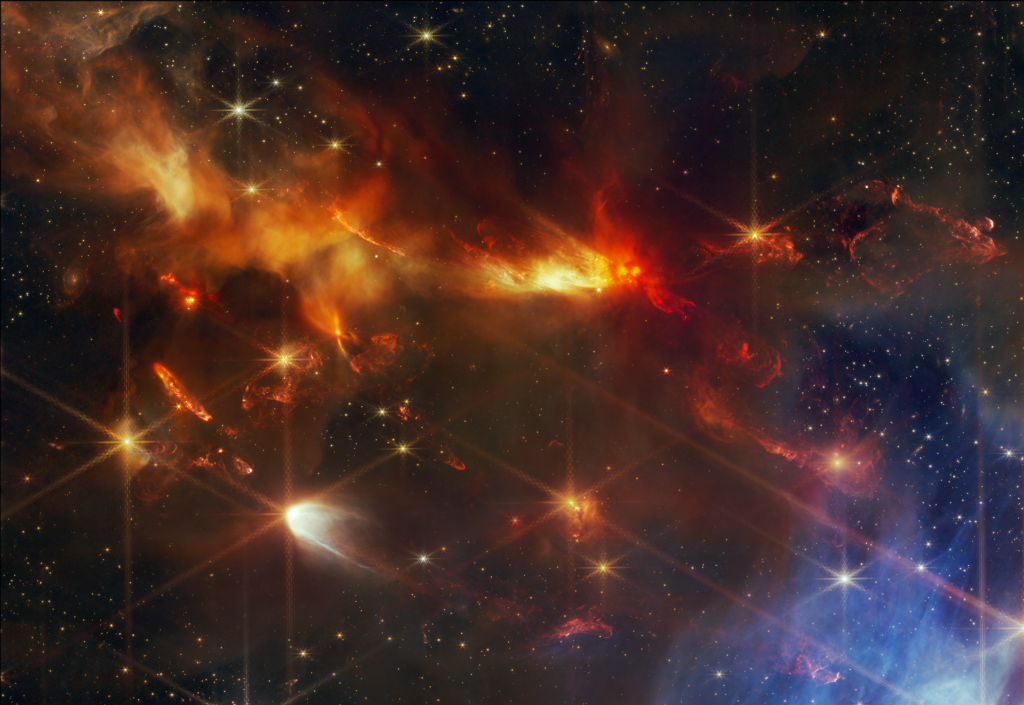
Jets of material blasting from newborn stars, are captured in this James Webb Space Telescope close-up of the Serpens Nebula. The powerful protostellar outflows are bipolar, twin jets spewing in opposite directions. Their directions are perpendicular to accretion disks formed around the spinning, collapsing stellar infants. In the NIRcam image, the reddish color represents emission from molecular hydrogen and carbon monoxide produced as the jets collide with the surrounding gas and dust. The sharp image shows for the first time that individual outflows detected in the Serpens Nebula are generally aligned along the same direction. That result was expected, but has only now come into clear view with Webb's detailed exploration of the active young star-forming region. Brighter foreground stars exhibit Webb's characteristic diffraction spikes. At the Serpens Nebula's estimated distance of 1,300 light-years, this cosmic close-up frame is about 1 light-year across.