Andromeda Galaxy
The Andromeda Galaxy (M31) is the nearest major galaxy to the Milky Way, located about 2.5 million light-years away. It is a spiral galaxy similar in structure to our own.
Source: science.nasa.gov
APODs including "Andromeda Galaxy"
Spiral Galaxy NGC 4038 in Collision
12/08/2012
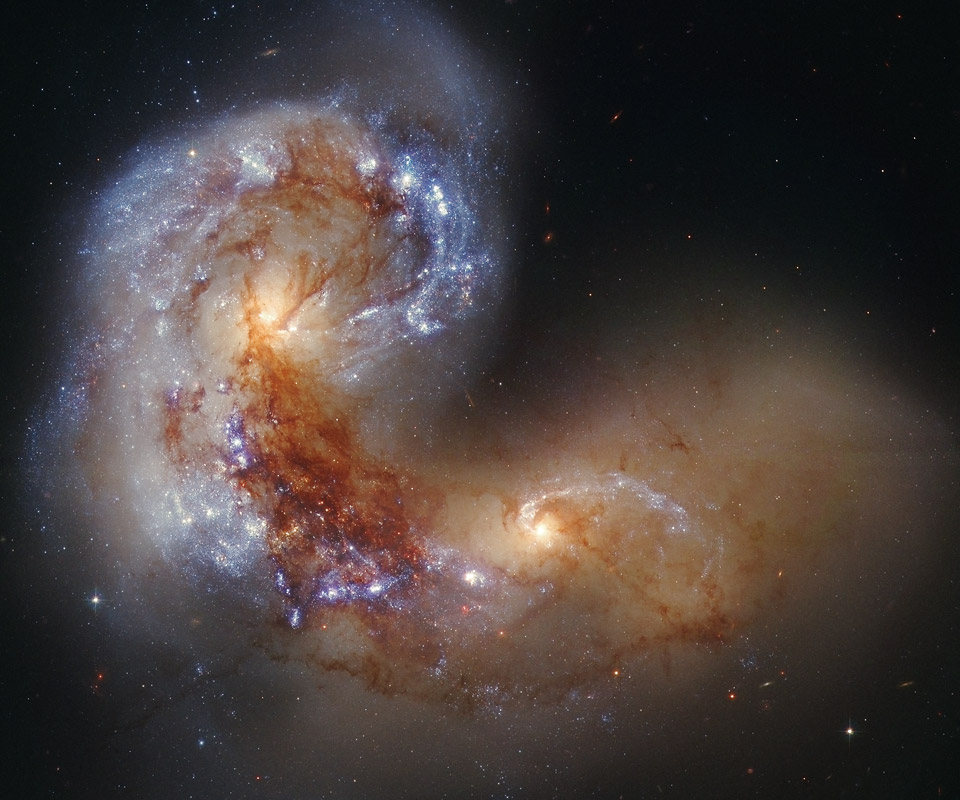
This galaxy is having a bad millennium. In fact, the past 100 million years haven't been so good, and probably the next billion or so will be quite tumultuous. Visible on the upper left, NGC 4038 used to be a normal spiral galaxy, minding its own business, until NGC 4039, toward its right, crashed into it. The evolving wreckage, known famously as the Antennae, is pictured above. As gravity restructures each galaxy, clouds of gas slam into each other, bright blue knots of stars form, massive stars form and explode, and brown filaments of dust are strewn about. Eventually the two galaxies will converge into one larger spiral galaxy. Such collisions are not unusual, and even our own Milky Way Galaxy has undergone several in the past and is predicted to collide with our neighboring Andromeda Galaxy in a few billion years. The frames that compose this image were taken by the orbiting Hubble Space Telescope by professional astronomers to better understand galaxy collisions. These frames -- and many other deep space images from Hubble -- have since been made public, allowing an interested amateur to download and process them into this visually stunning composite. Growing Gallery: Perseid Meteor Shower 2012