Andromeda Galaxy
The Andromeda Galaxy, also known as Messier 31 or M31, is the closest large spiral galaxy to the Milky Way, located about 2.5 million light-years away in the constellation Andromeda.
It is a barred spiral galaxy with a diameter of approximately 200,000 to 260,000 light-years and contains around one trillion stars, making it the most massive galaxy in the Local Group, which also includes the Milky Way, Triangulum Galaxy, and about 50 smaller galaxies.
Under dark skies, Andromeda is visible to the naked eye as a faint, elongated smudge—its apparent size on the sky spans more than six times the diameter of the full Moon. A panoramic Hubble mosaic captured more than 100 million stars across a 40,000-light-year swath of its disk.
Observations from Hubble and other observatories have revealed Andromeda’s rich and turbulent history, including remnants of smaller galaxies it has absorbed and an enormous halo of hot gas that extends far beyond its visible disk.
The Andromeda Galaxy is approaching the Milky Way at about 110 kilometers per second, and while a direct collision is likely in about 4 to 5 billion years, recent studies suggest there is a possibility the two galaxies could instead pass near each other or merge in a more complex interaction.
Due to its proximity and similarities to the Milky Way, Andromeda serves as a vital reference for understanding spiral galaxy formation, structure, and future cosmic evolution—including the eventual fate of our own galaxy.
Sources
APODs including "Andromeda Galaxy"
Andromeda Through Gas and Dust
3 June 2026
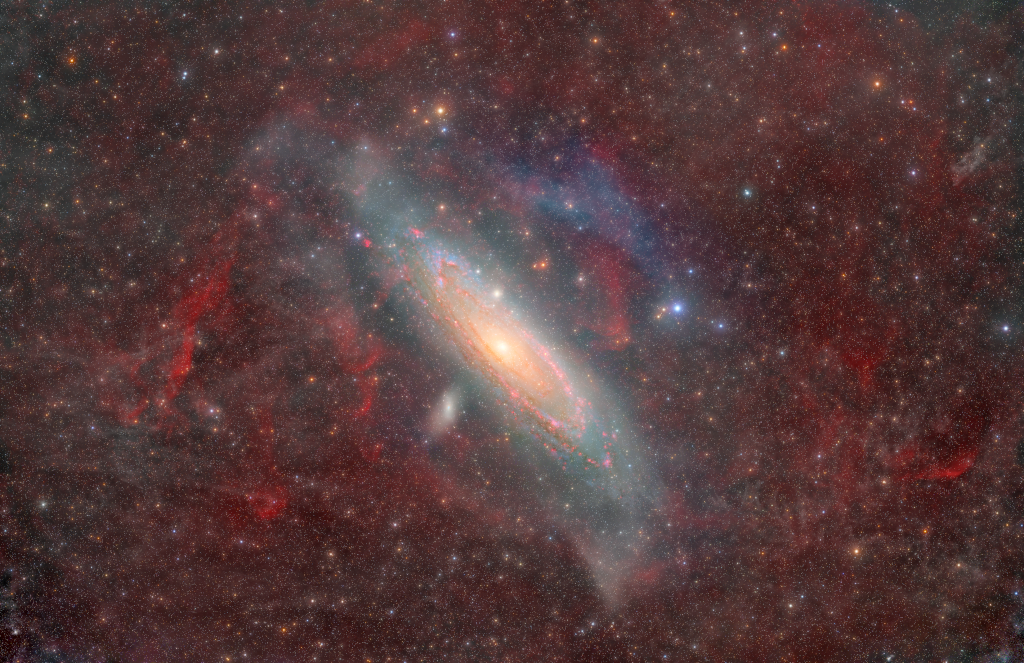
Over 1000 years ago, Persian astronomer Abd al-Rahman al-Sufi published humanity’s oldest known record of the Andromeda Galaxy in "The Book of Fixed Stars" (Bodleian Library MS. Marsh 144 p. 167). 800 years later, Andromeda became the 31st entry in Charles Messier’s "Catalogue of Nebulae and Star Clusters". From “a small cloud” to “nebula” and now known to be our nearest major galaxy, Andromeda has remained a fundamental astronomical object. Today’s image, taken over 202 hours, shows how far we have come in our ability to observe our neighbor. The diffuse red and blue clouds are mostly foreground ionized hydrogen and oxygen well within our Milky Way. Pink-red clouds of hydrogen ionized by the energetic light of young stars trace the galaxy’s dusty spiral arms. M32 and M110 are satellite galaxies pictured orbiting the larger Andromeda. Despite its long history of observation through ancient unaided eyes to modern telescopes, Andromeda still holds countless secrets that astronomers will continue to search for, including how galaxies merge and evolve, as well as the nature of the dark matter that galaxies reside in. Teachers! the NASA/IPAC Teacher Archive Research Program is officially open for applications!