Apollo 16
Apollo 16 was NASA’s tenth crewed lunar landing mission and the fifth to land on the Moon. Launched on April 16, 1972, it touched down in the Descartes Highlands on April 21, carrying astronauts John Young and Charles Duke, with Ken Mattingly orbiting above. The mission’s objectives included geological fieldwork using the Lunar Roving Vehicle, deployment of surface experiments (ALSEP), and the return of nearly 96 kg of lunar samples. The mission concluded with a safe Earth splashdown on April 27, 1972.
Source: nasa.gov
APODs including "Apollo 16"
The First Lunar Observatory
08/06/1996
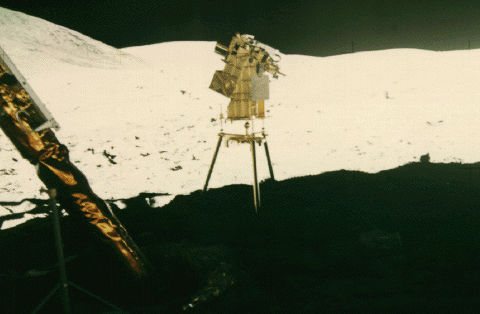
The first and only lunar astronomical observatory was deployed by the Apollo 16 crew in 1972. The Far Ultraviolet Camera / Spectrograph used a 3-inch diameter telescope to photograph the Earth, various nebulae, star clusters, and the Large Magellanic Cloud. The camera is seen above placed in the shadow of the Lunar Module so it would not overheat. A leg of the Lunar Module enters the picture from the left. The camera took pictures in ultraviolet light which would normally be blocked by the Earth's atmosphere. The Far Ultraviolet Camera was created by George Carruthers (NRL), had a field of view of 20 degrees, and could detect stars having visual magnitude brighter than 11. 178 images were recorded in a film cartridge which was returned to Earth. The observatory stands on the Moon even today.