Apollo 16
Apollo 16 was NASA’s tenth crewed lunar landing mission and the fifth to land on the Moon. Launched on April 16, 1972, it touched down in the Descartes Highlands on April 21, carrying astronauts John Young and Charles Duke, with Ken Mattingly orbiting above. The mission’s objectives included geological fieldwork using the Lunar Roving Vehicle, deployment of surface experiments (ALSEP), and the return of nearly 96 kg of lunar samples. The mission concluded with a safe Earth splashdown on April 27, 1972.
Source: nasa.gov
APODs including "Apollo 16"
Ultraviolet Earth
10/06/1996
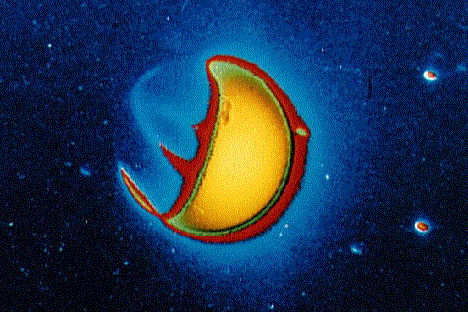
Here's a switch: the above picture is of the Earth taken from a lunar observatory! This false color picture shows how the Earth glows in ultraviolet (UV) light. UV light is so blue humans can't see it. Very little UV light is transmitted through the Earth's atmosphere but what sunlight does make it through can cause a sunburn. The Far UV Camera / Spectrograph deployed and left on the Moon by the crew of Apollo 16 took the above picture. The part of the Earth facing the Sun reflects much UV light, but perhaps more interesting is the side facing away from the Sun. Here bands of UV emission are also apparent. These bands are the result of aurora and are caused by charged particles expelled by the Sun spiraling to Earth along magnetic field lines.