Apollo 16
Apollo 16 was NASA’s tenth crewed lunar landing mission and the fifth to land on the Moon. Launched on April 16, 1972, it touched down in the Descartes Highlands on April 21, carrying astronauts John Young and Charles Duke, with Ken Mattingly orbiting above. The mission’s objectives included geological fieldwork using the Lunar Roving Vehicle, deployment of surface experiments (ALSEP), and the return of nearly 96 kg of lunar samples. The mission concluded with a safe Earth splashdown on April 27, 1972.
Source: nasa.gov
APODs including "Apollo 16"
Apollo 16: Exploring Plum Crater
20/12/1997
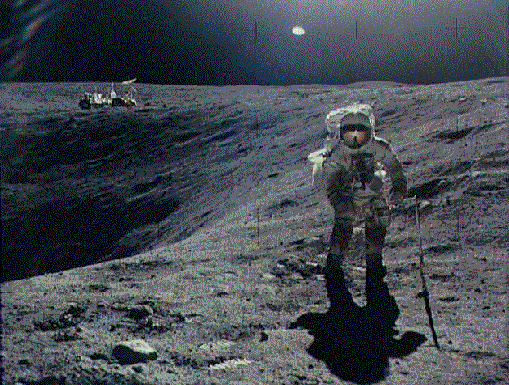
Apollo 16 spent three days on Earth's Moon in April 1972. The fifth lunar landing mission out of six, Apollo 16 was famous for deploying and using an ultraviolet telescope as the first lunar observatory, and for collecting rocks and data on the mysterious lunar highlands. In the above picture, astronaut John W. Young photographs Charles M. Duke, Jr. collecting rock samples at the Descartes landing site. Duke stands by Plum Crater while the Lunar Roving Vehicle waits parked in the background. The Lunar Roving Vehicle allowed the astronauts to travel great distances to investigate surface features and collect rocks. High above, Thomas K. Mattingly orbits in the Command Module.