Big Bang
The Big Bang theory describes the universe's origin from an extremely hot, dense state around 13.8 billion years ago, followed by rapid expansion and cooling that continues to this day.
During the first fraction of a second—an era called inflation—the universe expanded exponentially, smoothing and flattening space. After inflation ended, the universe consisted of a highly energetic plasma of particles and radiation.
Within minutes, protons and neutrons combined to form light elements (hydrogen, helium, deuterium, and small amounts of lithium) in a process known as Big Bang nucleosynthesis.
About 380,000 years after the Big Bang, the universe cooled enough for electrons and nuclei to combine into neutral atoms. This allowed photons to travel freely, producing the Cosmic Microwave Background—the oldest light we can observe.
Over time, gravity amplified slight density variations in the plasma, leading to the formation of stars, galaxies, and large-scale structures.
Key evidence supporting the Big Bang includes the expansion of space (observed via galaxy redshifts), the abundance of light elements, and the precise measurements of the Cosmic Microwave Background by missions such as COBE, WMAP, and Planck.
Modern cosmological models (ΛCDM) incorporate dark matter and dark energy, explaining current observations of cosmic acceleration, geometry, and composition.
Sources
APODs including "Big Bang"
A Distant Galaxy in the Deep Field
28 June 1996
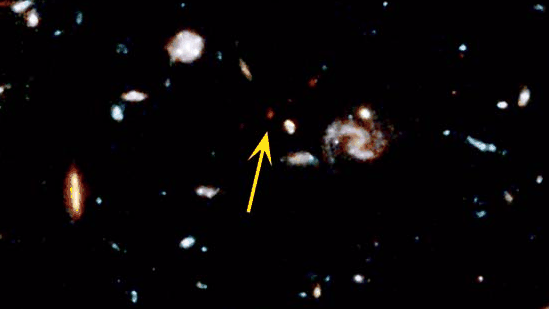
Researchers believe that the faint reddish smudge indicated by the arrow in the image above is a candidate for the most distant known galaxy which may have existed only a few hundred million years after the Big Bang. The image is part of the Hubble Deep Field, the Hubble Space Telescope's deepest yet picture of the Universe. Made in December 1995 by staring for ten consecutive days with the Hubble, astronomers have been intently studying the resulting deep field image filled with remote galaxies for clues to what galaxies and the Universe looked like in the distant past. While nearby galaxies are easily detected in the image - some seen here have visible elliptical and even spiral structures - the most distant (and therefore oldest) galaxies must be identified by examining their appearance in different wavelengths of light. Based on this technique, six of the most distant galaxies in the Deep Field appear to be farther away than even quasars.