Big Bang
The Big Bang theory describes the universe's origin from an extremely hot, dense state around 13.8 billion years ago, followed by rapid expansion and cooling that continues to this day.
During the first fraction of a second—an era called inflation—the universe expanded exponentially, smoothing and flattening space. After inflation ended, the universe consisted of a highly energetic plasma of particles and radiation.
Within minutes, protons and neutrons combined to form light elements (hydrogen, helium, deuterium, and small amounts of lithium) in a process known as Big Bang nucleosynthesis.
About 380,000 years after the Big Bang, the universe cooled enough for electrons and nuclei to combine into neutral atoms. This allowed photons to travel freely, producing the Cosmic Microwave Background—the oldest light we can observe.
Over time, gravity amplified slight density variations in the plasma, leading to the formation of stars, galaxies, and large-scale structures.
Key evidence supporting the Big Bang includes the expansion of space (observed via galaxy redshifts), the abundance of light elements, and the precise measurements of the Cosmic Microwave Background by missions such as COBE, WMAP, and Planck.
Modern cosmological models (ΛCDM) incorporate dark matter and dark energy, explaining current observations of cosmic acceleration, geometry, and composition.
Sources
APODs including "Big Bang"
Two Billion Years After the Big Bang
7 September 1996
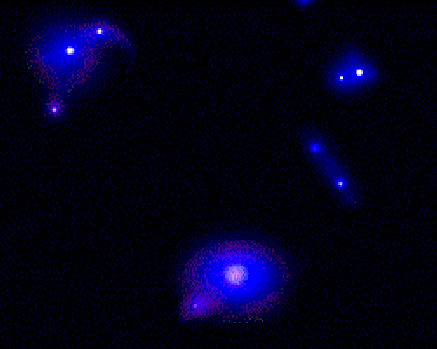
What did the universe look like two billion years after the Big Bang? According to this computer model, the universe was filled with irregular looking objects like the ones shown above. The simulation then predicts that these blobs of stars and gas collide to form galaxies more similar to the ones we see today. In fact, this simulation bears much resemblance to recent pictures of distant galaxies taken by the Hubble Space Telescope. Galaxy formation is a complex phenomena which only now is becoming understood. Did most galaxies form 5 billion years ago - or 10 billion? Did galaxies fragment from larger sheets of matter, or are they conglomerations of many smaller clumps? Simulations like this one are helping to determine the answer.