Big Bang
The Big Bang theory describes the universe's origin from an extremely hot, dense state around 13.8 billion years ago, followed by rapid expansion and cooling that continues to this day.
During the first fraction of a second—an era called inflation—the universe expanded exponentially, smoothing and flattening space. After inflation ended, the universe consisted of a highly energetic plasma of particles and radiation.
Within minutes, protons and neutrons combined to form light elements (hydrogen, helium, deuterium, and small amounts of lithium) in a process known as Big Bang nucleosynthesis.
About 380,000 years after the Big Bang, the universe cooled enough for electrons and nuclei to combine into neutral atoms. This allowed photons to travel freely, producing the Cosmic Microwave Background—the oldest light we can observe.
Over time, gravity amplified slight density variations in the plasma, leading to the formation of stars, galaxies, and large-scale structures.
Key evidence supporting the Big Bang includes the expansion of space (observed via galaxy redshifts), the abundance of light elements, and the precise measurements of the Cosmic Microwave Background by missions such as COBE, WMAP, and Planck.
Modern cosmological models (ΛCDM) incorporate dark matter and dark energy, explaining current observations of cosmic acceleration, geometry, and composition.
Sources
APODs including "Big Bang"
Cosmology Solved?
4 November 1998
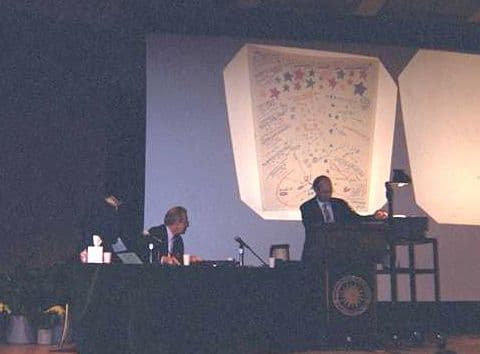
At the Nature of the Universe Debate held last month at the Smithsonian, top cosmologists P. James E. Peebles (Princeton) and Michael S. Turner (Chicago) argued over whether new data is finally resolving the type of universe in which we live. Turner, pictured speaking above, argued that a universe that underwent an early, rapid, inflationary expansion now looks particularly strong, potentially explaining even new data that indicates some sort of dark energy. Peebles, watching, was more cautious, agreeing that the evidence for a big bang is strong, but arguing that the specific type is still unclear. Peebles noted that a big bang leaving little but low-density matter still could not be ruled out. Both Turner and Peebles agreed that this is an exciting time, as data should continue to pour in and curious astrophysicists scramble to decode the geometry of the universe. Margaret J. Geller (Harvard Smithsonian), the debate moderator, looks on. The event was sponsored by the Smithsonian, the National Science Foundation, NASA, Michigan Technological University, and USRA. It was held in the honor of David N. Schramm.