Big Bang
The Big Bang theory describes the universe's origin from an extremely hot, dense state around 13.8 billion years ago, followed by rapid expansion and cooling that continues to this day.
During the first fraction of a second—an era called inflation—the universe expanded exponentially, smoothing and flattening space. After inflation ended, the universe consisted of a highly energetic plasma of particles and radiation.
Within minutes, protons and neutrons combined to form light elements (hydrogen, helium, deuterium, and small amounts of lithium) in a process known as Big Bang nucleosynthesis.
About 380,000 years after the Big Bang, the universe cooled enough for electrons and nuclei to combine into neutral atoms. This allowed photons to travel freely, producing the Cosmic Microwave Background—the oldest light we can observe.
Over time, gravity amplified slight density variations in the plasma, leading to the formation of stars, galaxies, and large-scale structures.
Key evidence supporting the Big Bang includes the expansion of space (observed via galaxy redshifts), the abundance of light elements, and the precise measurements of the Cosmic Microwave Background by missions such as COBE, WMAP, and Planck.
Modern cosmological models (ΛCDM) incorporate dark matter and dark energy, explaining current observations of cosmic acceleration, geometry, and composition.
Sources
APODs including "Big Bang"
Antarctica Hears Little Normal Matter in the Big Bang
1 May 2001
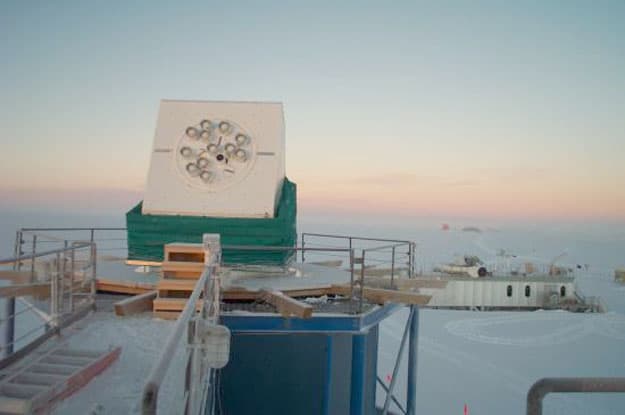
On the frozen ice near the bottom of our world, increasingly sophisticated instruments listen for a more precise echo of how our universe started. Sunday, independent collaborations behind three such instruments announced evidence that overtones heard are consistent with our universe having only about five percent normal matter and 95 percent dark matter or dark energy. This amount of normal matter was expected were our universe to have undergone a particularly explosive early phase of the big bang known as inflation. The measurements were actually made on the angular scale of 1/10th degree by detecting slight fluctuations of microwave light that occur in cosmic background radiation. These fluctuations are thought to be caused by sound waves moving through the early universe. Pictured above is the remote receiver for the Degree Angular Scale Interferometer (DASI) that recorded one of the data sets. Similar results were reported Sunday by the BOOMERANG and MAXIMA collaborations.