Big Bang
The Big Bang theory describes the universe's origin from an extremely hot, dense state around 13.8 billion years ago, followed by rapid expansion and cooling that continues to this day.
During the first fraction of a second—an era called inflation—the universe expanded exponentially, smoothing and flattening space. After inflation ended, the universe consisted of a highly energetic plasma of particles and radiation.
Within minutes, protons and neutrons combined to form light elements (hydrogen, helium, deuterium, and small amounts of lithium) in a process known as Big Bang nucleosynthesis.
About 380,000 years after the Big Bang, the universe cooled enough for electrons and nuclei to combine into neutral atoms. This allowed photons to travel freely, producing the Cosmic Microwave Background—the oldest light we can observe.
Over time, gravity amplified slight density variations in the plasma, leading to the formation of stars, galaxies, and large-scale structures.
Key evidence supporting the Big Bang includes the expansion of space (observed via galaxy redshifts), the abundance of light elements, and the precise measurements of the Cosmic Microwave Background by missions such as COBE, WMAP, and Planck.
Modern cosmological models (ΛCDM) incorporate dark matter and dark energy, explaining current observations of cosmic acceleration, geometry, and composition.
Sources
APODs including "Big Bang"
GRB 090423: The Farthest Explosion Yet Measured
29 April 2009
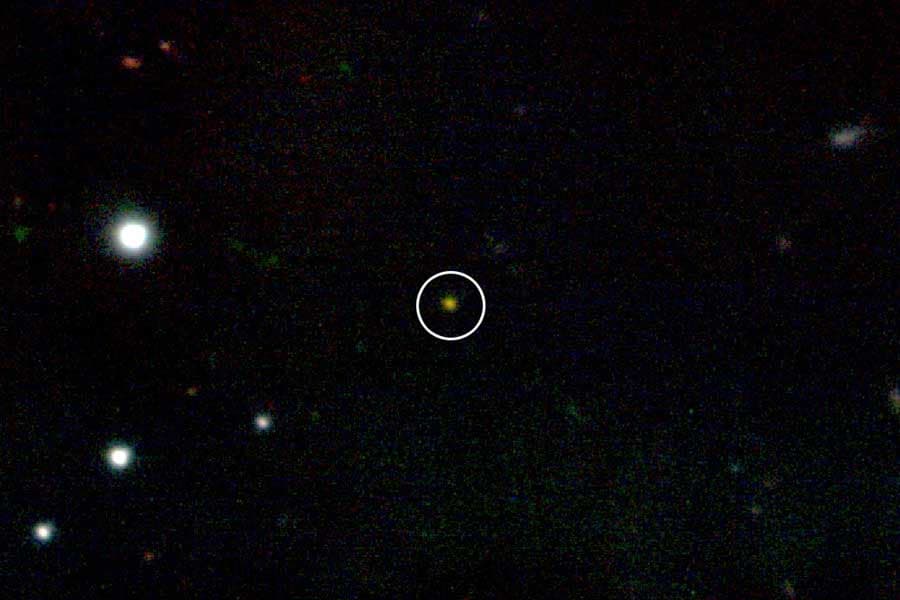
An explosion so powerful it was seen clear across the visible universe was recorded in gamma-radiation last week by NASA's orbiting Swift Observatory. Farther than any known galaxy, quasar, or optical supernova, the gamma-ray burst recorded last week was clocked at redshift 8.2, making it the farthest explosion of any type yet detected. Occurring only 630 million years after the Big Bang, GRB 090423 detonated so early that astronomers had no direct evidence that anything explodable even existed back then. The faint infrared afterglow of GRB 090423 was recovered by large ground telescopes within minutes of being discovered. The afterglow is circled in the above picture taken by the large Gemini North Telescope in Hawaii, USA. An exciting possibility is that this gamma-ray burst occurred in one of the very first generation of stars and announced the birth of an early black hole. Surely, GRB 090423 provides unique data from a relatively unexplored epoch in our universe and a distant beacon from which the intervening universe can be studied.