Big Bang
The Big Bang theory describes the universe's origin from an extremely hot, dense state around 13.8 billion years ago, followed by rapid expansion and cooling that continues to this day.
During the first fraction of a second—an era called inflation—the universe expanded exponentially, smoothing and flattening space. After inflation ended, the universe consisted of a highly energetic plasma of particles and radiation.
Within minutes, protons and neutrons combined to form light elements (hydrogen, helium, deuterium, and small amounts of lithium) in a process known as Big Bang nucleosynthesis.
About 380,000 years after the Big Bang, the universe cooled enough for electrons and nuclei to combine into neutral atoms. This allowed photons to travel freely, producing the Cosmic Microwave Background—the oldest light we can observe.
Over time, gravity amplified slight density variations in the plasma, leading to the formation of stars, galaxies, and large-scale structures.
Key evidence supporting the Big Bang includes the expansion of space (observed via galaxy redshifts), the abundance of light elements, and the precise measurements of the Cosmic Microwave Background by missions such as COBE, WMAP, and Planck.
Modern cosmological models (ΛCDM) incorporate dark matter and dark energy, explaining current observations of cosmic acceleration, geometry, and composition.
Sources
APODs including "Big Bang"
Caught in the Afterglow
24 November 2011
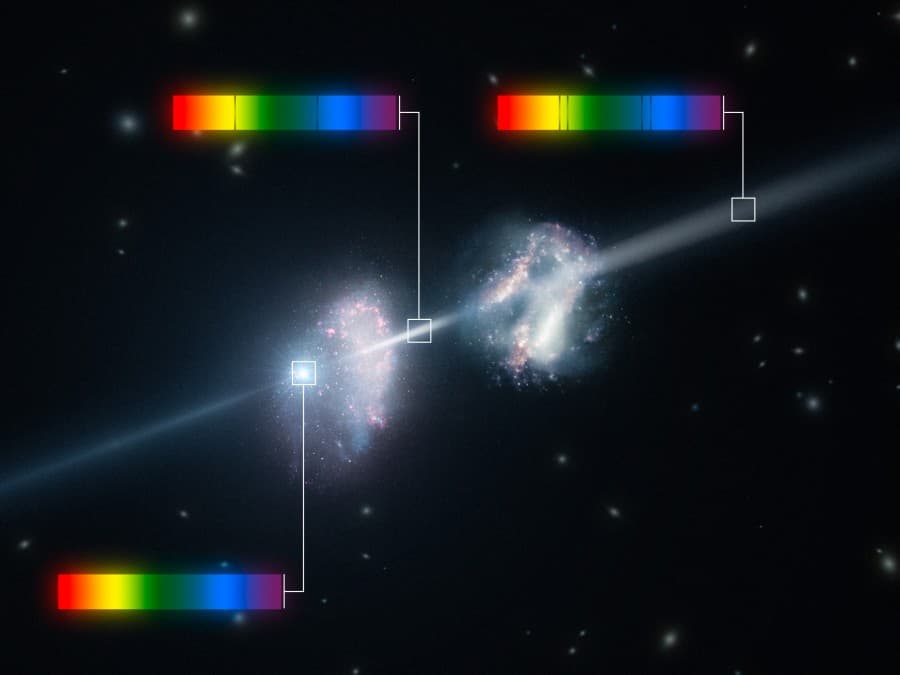
In this artist's illustration, two distant galaxies formed about 2 billion years after the big bang are caught in the afterglow of GRB090323, a gamma-ray burst seen across the Universe. Shining through its own host galaxy and another nearby galaxy, the alignment of gamma-ray burst and galaxies was inferred from the afterglow spectrum following the burst's initial detection by the Fermi Gamma Ray Space Telescope in March of 2009. As seen by one of the European Southern Observatory's very large telescope units, the spectrum of the burst's fading afterglow also offered a surprising result - the distant galaxies are richer in heavy elements than the Sun, with the highest abundances ever seen in the early Universe. Heavy elements that enrich mature galaxies in the local Universe were made in past generations of stars. So these young galaxies have experienced a prodigious rate of star formation and chemical evolution compared to our own Milky Way. In the illustration, the light from the burst site at the left passes successively through the galaxies to the right. Spectra illustrating dark absorption lines of the galaxies' elements imprinted on the afterglow light are shown as insets. Of course, astronomers on planet Earth would be about 12 billion light-years off the right edge of the frame.