Big Bang
The Big Bang theory describes the universe's origin from an extremely hot, dense state around 13.8 billion years ago, followed by rapid expansion and cooling that continues to this day.
During the first fraction of a second—an era called inflation—the universe expanded exponentially, smoothing and flattening space. After inflation ended, the universe consisted of a highly energetic plasma of particles and radiation.
Within minutes, protons and neutrons combined to form light elements (hydrogen, helium, deuterium, and small amounts of lithium) in a process known as Big Bang nucleosynthesis.
About 380,000 years after the Big Bang, the universe cooled enough for electrons and nuclei to combine into neutral atoms. This allowed photons to travel freely, producing the Cosmic Microwave Background—the oldest light we can observe.
Over time, gravity amplified slight density variations in the plasma, leading to the formation of stars, galaxies, and large-scale structures.
Key evidence supporting the Big Bang includes the expansion of space (observed via galaxy redshifts), the abundance of light elements, and the precise measurements of the Cosmic Microwave Background by missions such as COBE, WMAP, and Planck.
Modern cosmological models (ΛCDM) incorporate dark matter and dark energy, explaining current observations of cosmic acceleration, geometry, and composition.
Sources
APODs including "Big Bang"
A Hole in Mars
18 July 2012
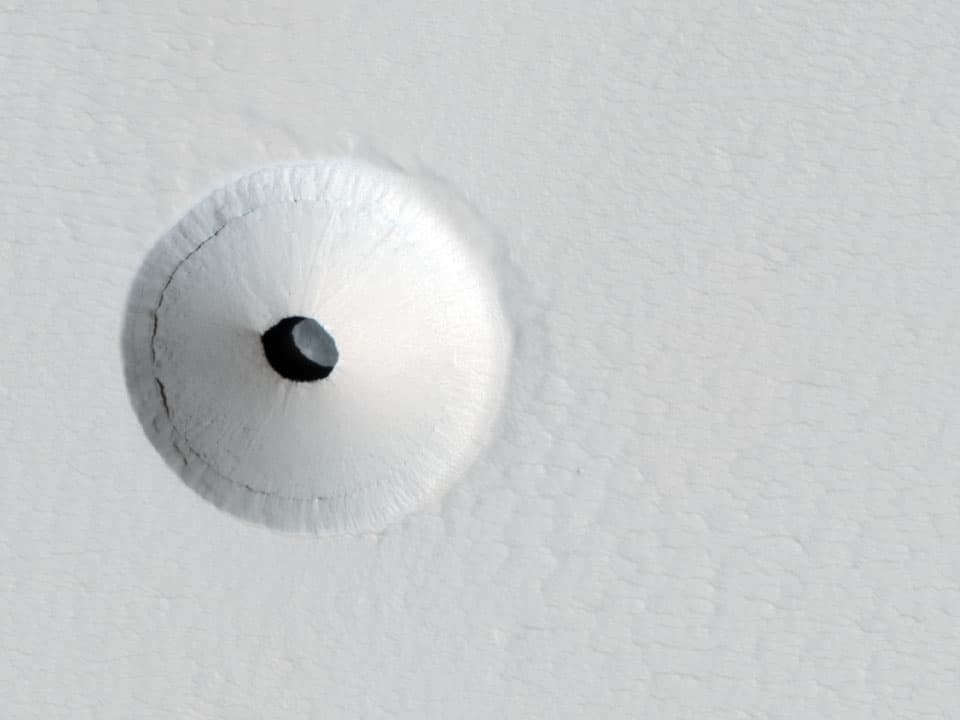
What created this unusual hole in Mars? The hole was discovered by chance on images of the dusty slopes of Mars' Pavonis Mons volcano taken by the HiRISE instrument aboard the robotic Mars Reconnaissance Orbiter currently circling Mars. The hole appears to be an opening to an underground cavern, partly illuminated on the image right. Analysis of this and follow-up images revealed the opening to be about 35 meters across, while the interior shadow angle indicates that the underlying cavern is roughly 20 meters deep. Why there is a circular crater surrounding this hole remains a topic of speculation, as is the full extent of the underlying cavern. Holes such as this are of particular interest because their interior caves are relatively protected from the harsh surface of Mars, making them relatively good candidates to contain Martian life. These pits are therefore prime targets for possible future spacecraft, robots, and even human interplanetary explorers. ASOW: From the Big Bang to the Nobel Prize and the End of the Universe by John C. Mather