Big Bang
The Big Bang theory describes the universe's origin from an extremely hot, dense state around 13.8 billion years ago, followed by rapid expansion and cooling that continues to this day.
During the first fraction of a second—an era called inflation—the universe expanded exponentially, smoothing and flattening space. After inflation ended, the universe consisted of a highly energetic plasma of particles and radiation.
Within minutes, protons and neutrons combined to form light elements (hydrogen, helium, deuterium, and small amounts of lithium) in a process known as Big Bang nucleosynthesis.
About 380,000 years after the Big Bang, the universe cooled enough for electrons and nuclei to combine into neutral atoms. This allowed photons to travel freely, producing the Cosmic Microwave Background—the oldest light we can observe.
Over time, gravity amplified slight density variations in the plasma, leading to the formation of stars, galaxies, and large-scale structures.
Key evidence supporting the Big Bang includes the expansion of space (observed via galaxy redshifts), the abundance of light elements, and the precise measurements of the Cosmic Microwave Background by missions such as COBE, WMAP, and Planck.
Modern cosmological models (ΛCDM) incorporate dark matter and dark energy, explaining current observations of cosmic acceleration, geometry, and composition.
Sources
APODs including "Big Bang"
Time Spiral
1 July 2024
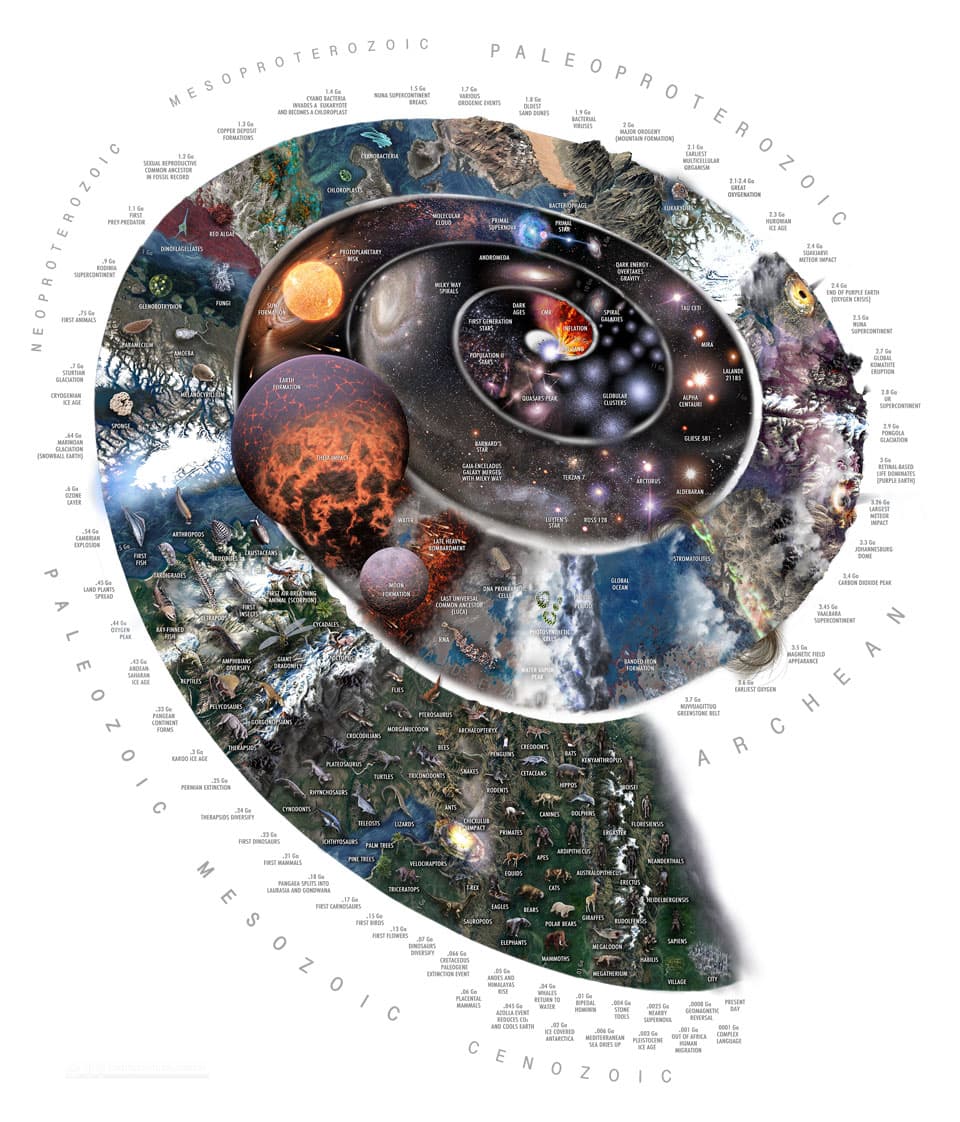
What's happened since the universe started? The time spiral shown here features a few notable highlights. At the spiral's center is the Big Bang, the place where time, as we know it, began about 13.8 billion years ago. Within a few billion years atoms formed, then stars formed from atoms, galaxies formed from stars and gas, our Sun formed, soon followed by our Earth, about 4.6 billion years ago. Life on Earth begins about 3.8 billion years ago, followed by cells, then photosynthesis within a billion years. About 1.7 billion years ago, multicellular life on Earth began to flourish. Fish began to swim about 500 million years ago, and mammals began walking on land about 200 million years ago. Humans first appeared only about 6 million years ago, and made the first cities only about 10,000 years ago. The time spiral illustrated stops there, but human spaceflight might be added, which started only 75 years ago, and useful artificial intelligence began to take hold within only the past few years. Explore Your Universe: Random APOD Generator