Big Bang
The Big Bang theory describes the universe's origin from an extremely hot, dense state around 13.8 billion years ago, followed by rapid expansion and cooling that continues to this day.
During the first fraction of a second—an era called inflation—the universe expanded exponentially, smoothing and flattening space. After inflation ended, the universe consisted of a highly energetic plasma of particles and radiation.
Within minutes, protons and neutrons combined to form light elements (hydrogen, helium, deuterium, and small amounts of lithium) in a process known as Big Bang nucleosynthesis.
About 380,000 years after the Big Bang, the universe cooled enough for electrons and nuclei to combine into neutral atoms. This allowed photons to travel freely, producing the Cosmic Microwave Background—the oldest light we can observe.
Over time, gravity amplified slight density variations in the plasma, leading to the formation of stars, galaxies, and large-scale structures.
Key evidence supporting the Big Bang includes the expansion of space (observed via galaxy redshifts), the abundance of light elements, and the precise measurements of the Cosmic Microwave Background by missions such as COBE, WMAP, and Planck.
Modern cosmological models (ΛCDM) incorporate dark matter and dark energy, explaining current observations of cosmic acceleration, geometry, and composition.
Sources
APODs including "Big Bang"
Where Your Elements Came From
14 September 2026
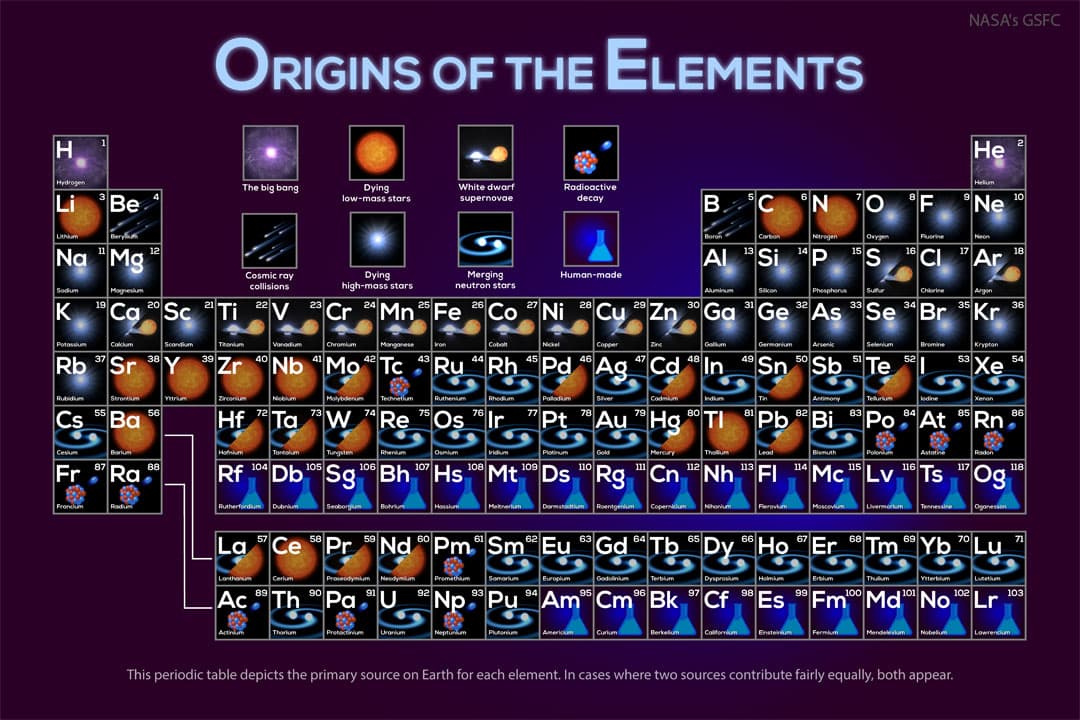
The hydrogen in your body and present in every molecule of water came from the Big Bang. There are no other appreciable sources of hydrogen in the universe. The carbon in your body was made by nuclear fusion in the interior of stars, as was the oxygen. Much of the iron in your body was made during supernovas of stars that occurred long ago and far away. The gold in your jewelry was likely made from neutron stars during collisions that may have been visible as short-duration gamma-ray bursts or gravitational wave events. Elements like phosphorus and copper are present in our bodies in only small amounts but are essential to the functioning of all known life. The featured periodic table is color coded to indicate humanity's best guess as to the nuclear origin of all known elements. The sites of nuclear creation of some elements, such as copper, are not really well known and are continuing topics of observational and computational research. APOD's main NASA site is moving: From apod.nasa.gov to science.nasa.gov/apod