Black Hole
A black hole is an astronomical object whose gravity is so strong that nothing—even light—can escape from within its event horizon. It forms when a massive star’s core collapses or through other processes, and may have an accretion disk of infalling matter that emits radiation. Supermassive black holes at galaxy centers influence stellar orbits, and mergers produce gravitational waves.
Source: nasa.gov
APODs including "Black Hole"
M77: Spiral with a Strange Glow
10/09/1996
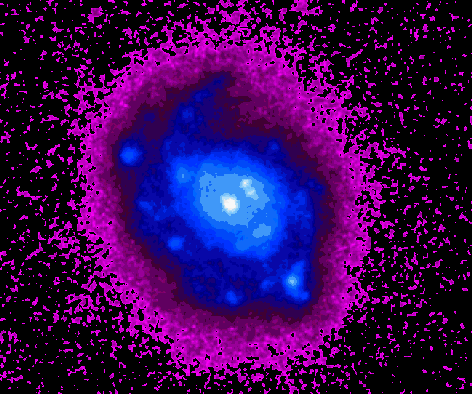
Why is M77 surrounded by an ultraviolet glow? M77, also called NGC 1068, appears at first sight to be a relatively normal barred spiral galaxy. But when photographed in the ultraviolet (UV), as shown above in false color, the galaxy sports an ultraviolet halo - shown as violet in the photograph. The blue spiral structure closer to the picture's center indicates normal ultraviolet emission from bright young stars that have recently formed there. Astronomers now hypothesize that the outer glow arises from UV light emitted from the galaxy's active center and reflected to us from clouds of gas and dust. These same gas and dust clouds obscure the active center of this Seyfert galaxy - where an ultramassive black hole is thought to live.