Black Hole
A black hole is an astronomical object whose gravity is so strong that nothing—even light—can escape from within its event horizon. It forms when a massive star’s core collapses or through other processes, and may have an accretion disk of infalling matter that emits radiation. Supermassive black holes at galaxy centers influence stellar orbits, and mergers produce gravitational waves.
Source: nasa.gov
APODs including "Black Hole"
In the Center of Spiral M77
11/09/1996
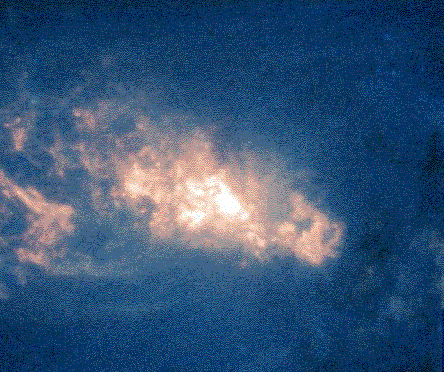
What is happening in the center of nearby spiral galaxy M77? To find out, astronomers used the Hubble Space Telescope to peer deep into the dusty chaos of this active galactic nucleus in 1994. They found a network of filamentary gas and opaque dust that provides only clues as to what central monster had left this mess. Due to the presence of hot ionized gas clouds near the core, changes in brightness that can take less than a week, and the ultraviolet halo surrounding the whole galaxy, the leading hypothesis is that a supermassive black hole lies at the center of this Seyfert Type 2 galaxy. Also known as NGC 1068, this galaxy lies only about 50 million light years distant and is visible with only a small telescope.