Black Hole
A black hole is an astronomical object whose gravity is so strong that nothing—even light—can escape from within its event horizon. It forms when a massive star’s core collapses or through other processes, and may have an accretion disk of infalling matter that emits radiation. Supermassive black holes at galaxy centers influence stellar orbits, and mergers produce gravitational waves.
Source: nasa.gov
APODs including "Black Hole"
The Double Nucleus of M31
11/10/1996
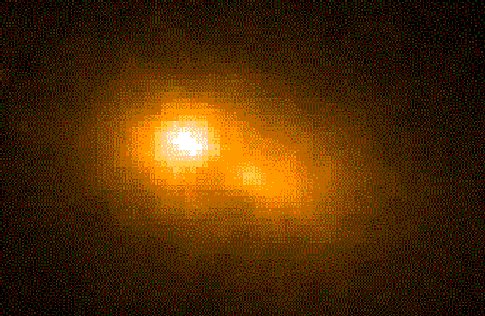
The center of M31 is twice as unusual as previously thought. In 1991 the Planetary Camera then onboard the Hubble Space Telescope pointed toward the center of our Milky Way's closest major galactic neighbor: Andromeda (M31). To everyone's surprise, M31's nucleus showed a double structure. The nuclear hot-spots are quite close together when considering Galactic distances: M31 is about 150,000 light years across while the above shows only the central 30 light-years. Subsequent ground-based observations have led to speculation that indeed two nuclei exist, are moving with respect to each other, that one nucleus is slowly tidally disrupting the other, and that one nucleus may be the remains of smaller galaxy "eaten" by M31. The nuclei of many galaxies, including M31, are known to be quite violent places, and the existence of massive black holes are frequently postulated to explain them.