Black Hole
A black hole is an astronomical object whose gravity is so strong that nothing—even light—can escape from within its event horizon. It forms when a massive star’s core collapses or through other processes, and may have an accretion disk of infalling matter that emits radiation. Supermassive black holes at galaxy centers influence stellar orbits, and mergers produce gravitational waves.
Source: nasa.gov
APODs including "Black Hole"
Spiral Galaxy NGC 3628 Edge On Credit:
01/11/1996
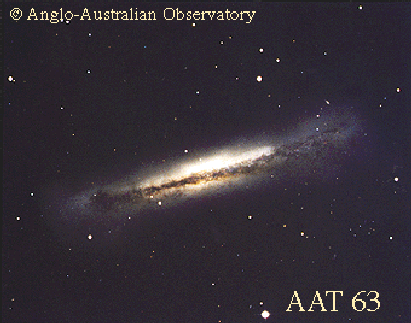
This is what a spiral galaxy looks like sideways. This view of NGC 3628 nearly resembles our own Milky Way Galaxy, which is also known to be a spiral. The dark band across the center is absorbed starlight caused by the galaxy's own interstellar dust. NGC 3628 is the faintest member of the Leo Triplet, a group of galaxies dominated by M65 and M66. The Leo Triplet lies about 35 million light years distant. The center of NGC 3628 emits variable X-ray radiation perhaps indicating the presence of a massive black hole.