Black Hole
A black hole is an astronomical object whose gravity is so strong that nothing—even light—can escape from within its event horizon. It forms when a massive star’s core collapses or through other processes, and may have an accretion disk of infalling matter that emits radiation. Supermassive black holes at galaxy centers influence stellar orbits, and mergers produce gravitational waves.
Source: nasa.gov
APODs including "Black Hole"
Name This Satellite
20/04/1998
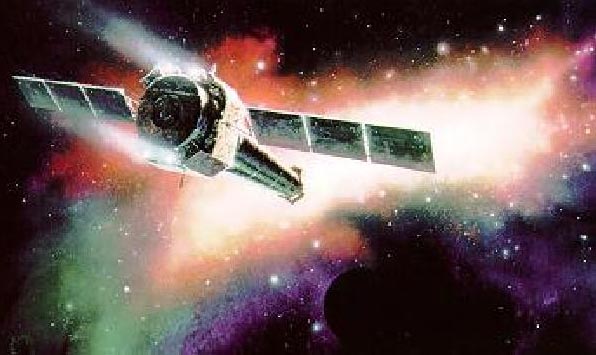
Can you name this satellite? In December, NASA's third Great Observatory is planned for launch. The two NASA Great Observatories currently in orbit are the Hubble Space Telescope and the Compton Gamma-Ray Observatory, both now named for famous scientists. But after whom should the Advanced X-ray Astrophysics Facility (AXAF) be named? If your submitted suggestion conforms with contest rules and is chosen, you will have named the most powerful X-ray satellite ever built, and may even win a prize. AXAF is the size of a bus, has strange mirrors polished to atomic smoothness, and will produce X-ray images five times clearer of objects twice as faint as any previous X-ray satellite. This should allow AXAF the ability to see X-rays emitted near small black holes, from distant active galaxies, and inside huge clusters of galaxies. Astronomers now hope for an uneventful launch, routine operations, and spectacular discoveries.