Black Hole
A black hole is an astronomical object whose gravity is so strong that nothing—even light—can escape from within its event horizon. It forms when a massive star’s core collapses or through other processes, and may have an accretion disk of infalling matter that emits radiation. Supermassive black holes at galaxy centers influence stellar orbits, and mergers produce gravitational waves.
Source: nasa.gov
APODs including "Black Hole"
The Doomed Dust Disk of NGC 7052
22/06/1998
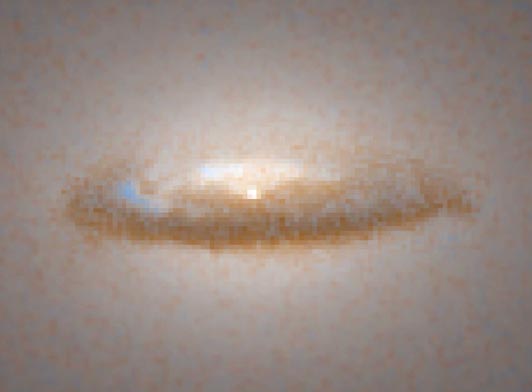
What created the dust disk in the center of NGC 7052, and what keeps it spinning? Although the disk might appear as a relatively tame "hubcap in space", the unusual center of elliptical galaxy NGC 7052 is probably the remnant of a titanic collision between galaxies. What's more, the disk's spin indicates the tremendous gravity of a massive central black hole. Analysis of this recently released photo by the Hubble Space Telescope indicates that the disk is thousands of light-years across, rotates faster than 100 kilometers per second, at a distance of 150 light-years from the center, and contains more mass than a million Suns. The theorized central black hole is thought to be yet 100 times more massive, and may swallow the entire disk in the next few million years.