Black Hole
A black hole is an astronomical object whose gravity is so strong that nothing—even light—can escape from within its event horizon. It forms when a massive star’s core collapses or through other processes, and may have an accretion disk of infalling matter that emits radiation. Supermassive black holes at galaxy centers influence stellar orbits, and mergers produce gravitational waves.
Source: nasa.gov
APODs including "Black Hole"
The Cosmic X-Ray Background
09/11/2000
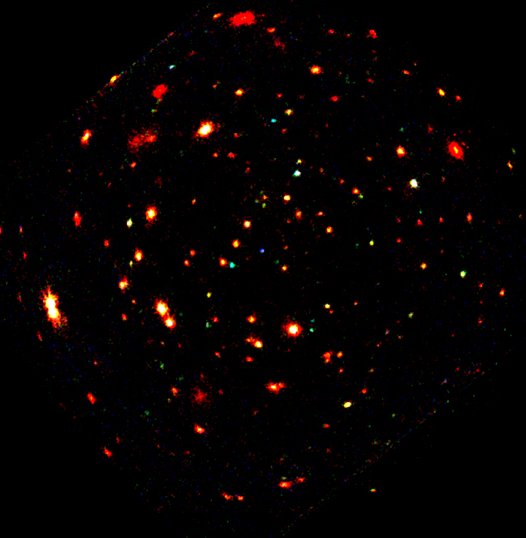
rly on, x-ray satellites revealed a surprising cosmic background glow of x-rays and astronomers have struggled to understand its origin. Now, peering through a hole in the obscuring gas and dust of our own Milky Way Galaxy, the powerful orbiting XMM-Newton telescope has recorded this deep image of the x-ray sky, resolving some of the mysterious background into many faint individual sources. The tantalizing image is color-coded, with red representing relatively low energy x-rays, photons with 500 or so times the energy of visible light. Green and blue colors correspond to increasingly energetic x-rays with up to about 10,000 times visible light energies. Notably, the faint sources tend to be green and blue, showing x-ray characteristics of huge amounts of material falling into massive black holes in very distant galaxies. Do massive black holes reside in the hearts of all large galaxies? The XMM-Newton results add to the growing consensus that they do and that, from across the universe, x-rays produced as matter feeds these black holes account for the cosmic x-ray background.