Black Hole
A black hole is an astronomical object whose gravity is so strong that nothing—even light—can escape from within its event horizon. It forms when a massive star’s core collapses or through other processes, and may have an accretion disk of infalling matter that emits radiation. Supermassive black holes at galaxy centers influence stellar orbits, and mergers produce gravitational waves.
Source: nasa.gov
APODs including "Black Hole"
Galactic Center Flicker Indicates Black Hole
10/09/2001
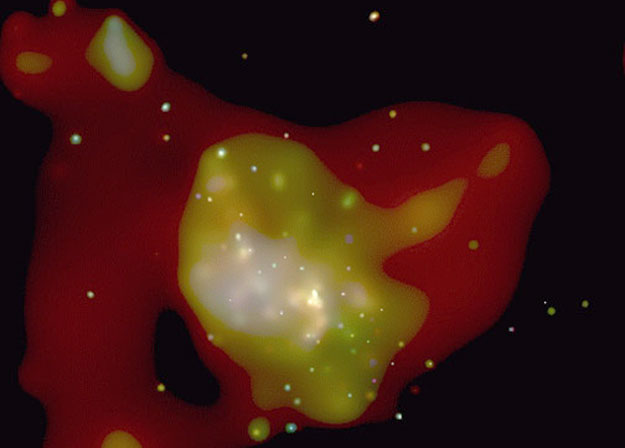
Why would the center of our Galaxy flicker? Many astronomers believe the only credible answer involves a black hole. During observations of Sagittarius A* with the orbiting Chandra X-ray Observatory, the bright X-ray source at the very center of our Milky Way brightened dramatically for a few minutes. Sagittarius A* is visible as the bright dot near the center of the above image. Since large objects cannot vary quickly, a small source is implicated in the variation. Evidence including the motions of central stars indicates that the center of our Galaxy is a massive place, however, estimated to be over a million times the mass of our Sun. Only one known type of object can fit so much mass in so small a volume: a black hole. This short flicker therefore provides additional evidence that a black hole does indeed reside at our Galaxy's center. If true, the flicker might have been caused by an object disrupting as it fell toward the disruptive monster.