Black Hole
A black hole is an astronomical object whose gravity is so strong that nothing—even light—can escape from within its event horizon. It forms when a massive star’s core collapses or through other processes, and may have an accretion disk of infalling matter that emits radiation. Supermassive black holes at galaxy centers influence stellar orbits, and mergers produce gravitational waves.
Source: nasa.gov
APODs including "Black Hole"
Spinning Black Holes and MCG-6-30-15
29/10/2001
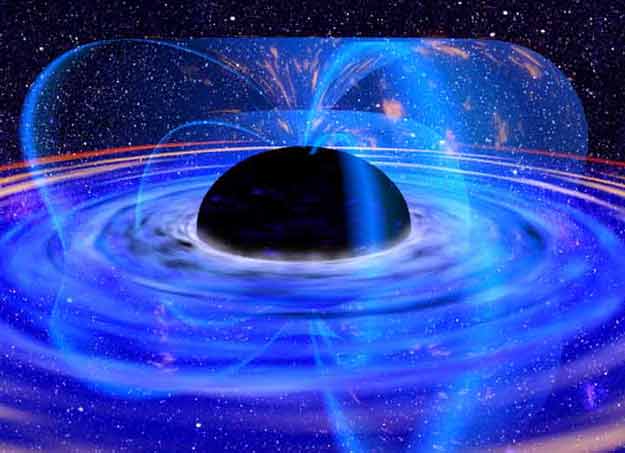
What makes the core of galaxy MCG-6-30-15 so bright? Some astronomers believe the answer is a massive spinning black hole. If so, this would be the first observational indication that it is possible to make a black hole act like a battery -- and tap into its rotational energy. MCG-6-30-15 is a distant galaxy that has recently been observed with the orbiting XMM-Newton satellite in X-ray light. These observations show the galaxy's nucleus not only to be very bright but also to show evidence that much of the light is climbing out of a deep gravitational well. A spinning black hole could explain both effects. A strong magnetic field could be the mediator transferring rotational energy from the black hole to the surrounding gas. Pictured above is an artist's illustration of a black hole surrounded by an accretion disk. For clarity, the illustration does not include distorting gravitational lens effects.