Black Hole
A black hole is an astronomical object whose gravity is so strong that nothing—even light—can escape from within its event horizon. It forms when a massive star’s core collapses or through other processes, and may have an accretion disk of infalling matter that emits radiation. Supermassive black holes at galaxy centers influence stellar orbits, and mergers produce gravitational waves.
Source: nasa.gov
APODs including "Black Hole"
Abell 2597's Cosmic Cavities
16/01/2002
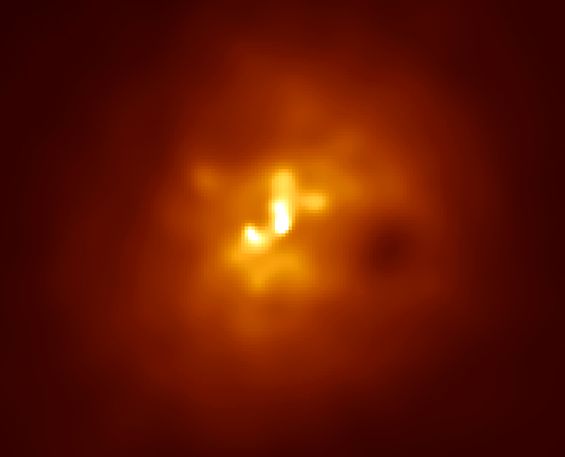
Typical of large galaxy clusters billions of light-years away, Abell 2597 features hundreds of galaxies embedded in a cloud of multimillion degree gas which glows in x-rays. This Chandra Observatory x-ray image shows the hot gas in this cluster's central regions and also reveals two large dark cavities within the x-ray glow; one below and right of center, the other above and left. Not a comment on dental health, Abell 2597's cavities are about 60,000 light-years across. They are thought to be remnants of a 100 million year old explosion originating from a supermassive black hole at the cluster's core. But the dim ghost cavities are not completely empty or they would have collapsed long ago. Instead they are likely filled with hotter gas, high energy particles, and magnetic fields and are moving away from the cluster center, like bubbles rising in champagne. Over the life of a galaxy cluster such explosions may happen over and over, creating a series of cavities which transport magnetic fields away from the cluster center. In fact, radio observations suggest another explosion has since occurred in the center of Abell 2597.