Black Hole
A black hole is an astronomical object whose gravity is so strong that nothing—even light—can escape from within its event horizon. It forms when a massive star’s core collapses or through other processes, and may have an accretion disk of infalling matter that emits radiation. Supermassive black holes at galaxy centers influence stellar orbits, and mergers produce gravitational waves.
Source: nasa.gov
APODs including "Black Hole"
Jets from Radio Galaxy 3C296
26/02/2002
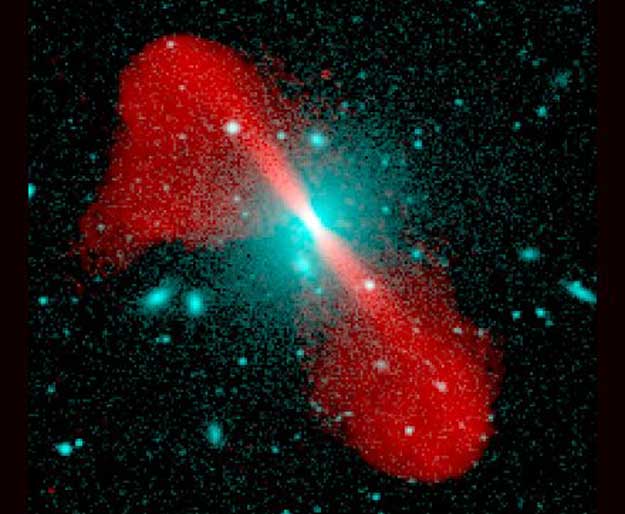
Jets of streaming plasma expelled by the central black hole of a massive elliptical galaxy likely light up this composite image of 3C296. The jets emanating from NGC 5532 and are nearly a million light years long. Exactly how the central black hole expels the infalling matter is still unknown. After clearing the galaxy, however, the jets inflate large radio bubbles that could glow for millions of years. If excited by a passing front, radio bubbles can even light up again after a billion years. Visible light is depicted in the above image in blue, while radio waves are shown in red. The radio map was created with the Very Large Array of radio telescopes.