Black Hole
A black hole is an astronomical object whose gravity is so strong that nothing—even light—can escape from within its event horizon. It forms when a massive star’s core collapses or through other processes, and may have an accretion disk of infalling matter that emits radiation. Supermassive black holes at galaxy centers influence stellar orbits, and mergers produce gravitational waves.
Source: nasa.gov
APODs including "Black Hole"
X-Rays from M83
06/02/2003
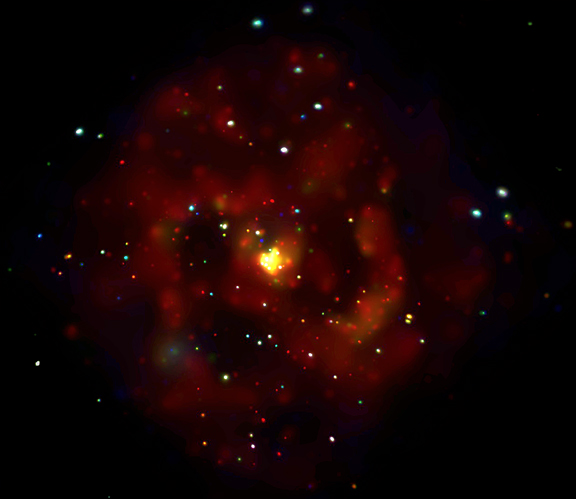
Bright and beautiful spiral galaxy M83 lies a mere twelve million light-years from Earth, toward the headstrong constellation Hydra. Sweeping spiral arms, prominent in visible light images, lend this galaxy its popular moniker -- the Southern Pinwheel. In fact, the spiral arms are still apparent in this Chandra Observatory false-color x-ray image of M83, traced by diffuse, hot, x-ray emitting gas. But more striking in the x-ray image is the galaxy's bright central region. The central emission likely represents even hotter gas created by a sudden burst of massive star formation. Point-like neutron star and black hole x-ray sources, final stages in the life cycles of massive stars, also show a concentration near the center of M83 and offer further evidence for a burst of star formation at this galaxy's core. Light from this burst of star formation would have first reached Earth some 20 million years ago.