Black Hole
A black hole is an astronomical object whose gravity is so strong that nothing—even light—can escape from within its event horizon. It forms when a massive star’s core collapses or through other processes, and may have an accretion disk of infalling matter that emits radiation. Supermassive black holes at galaxy centers influence stellar orbits, and mergers produce gravitational waves.
Source: nasa.gov
APODs including "Black Hole"
The Energetic Jet from Centaurus A
01/05/2003
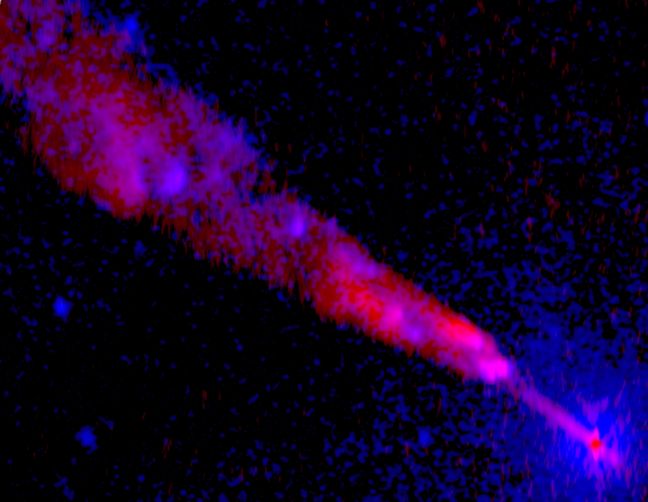
The center of well-studied active galaxy Centaurus A is hidden from the view of optical telescopes by a cosmic jumble of stars, gas, and dust. But both radio and x-ray telescopes can trace the remarkable jet of high-energy particles streaming from the galaxy's core. With Cen A's central region at the lower right, this composite false-color image shows the radio emission in red and x-rays in blue over the inner 4,000 light-years of the jet. One of the most detailed images of its kind, the picture shows how the x-ray and radio emitting sites are related along the jet, providing a road map to understanding the energetic stream. Extracting its energy from a supermassive black hole at the galaxy's center, the jet is confined to a relatively narrow angle and seems to produce most of its x-rays (bluer colors) at the upper left, farther from the core, where the jet begins to collide with Centaurus A's denser gas.