Black Hole
A black hole is an astronomical object whose gravity is so strong that nothing—even light—can escape from within its event horizon. It forms when a massive star’s core collapses or through other processes, and may have an accretion disk of infalling matter that emits radiation. Supermassive black holes at galaxy centers influence stellar orbits, and mergers produce gravitational waves.
Source: nasa.gov
APODs including "Black Hole"
Centaurus A: X-Rays from an Active Galaxy
05/07/2003
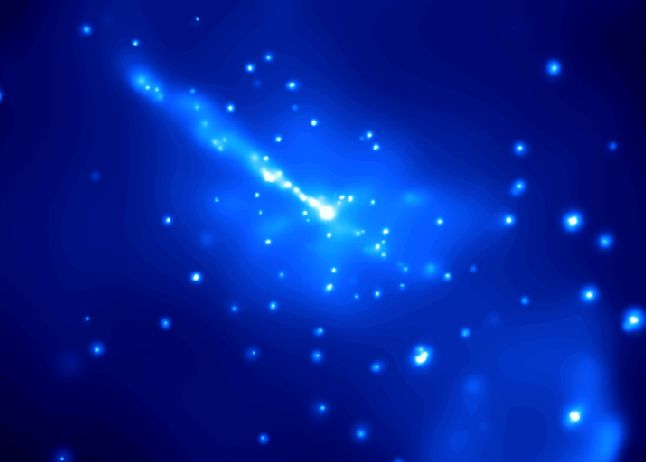
Its core hidden from optical view by a thick lane of dust, the giant elliptical galaxy Centaurus A was among the first objects observed by the orbiting Chandra X-ray Observatory. Astronomers were not disappointed, as Centaurus A's appearance in x-rays makes its classification as an active galaxy easy to appreciate. Perhaps the most striking feature of this Chandra false-color x-ray view is the jet, 30,000 light-years long. Blasting toward the upper left corner of the picture, the jet seems to arise from the galaxy's bright central x-ray source -- suspected of harboring a black hole with a million or so times the mass of the Sun. Centaurus A is also seen to be teeming with other individual x-ray sources and a pervasive, diffuse x-ray glow. Most of these individual sources are likely to be neutron stars or solar mass black holes accreting material from their less exotic binary companion stars. The diffuse high-energy glow represents gas throughout the galaxy heated to temperatures of millions of degrees C. At 11 million light-years distant in the constellation Centaurus, Centaurus A (NGC 5128) is the closest active galaxy.