Black Hole
A black hole is an astronomical object whose gravity is so strong that nothing—even light—can escape from within its event horizon. It forms when a massive star’s core collapses or through other processes, and may have an accretion disk of infalling matter that emits radiation. Supermassive black holes at galaxy centers influence stellar orbits, and mergers produce gravitational waves.
Source: nasa.gov
APODs including "Black Hole"
M87's Energetic Jet
11/12/2004
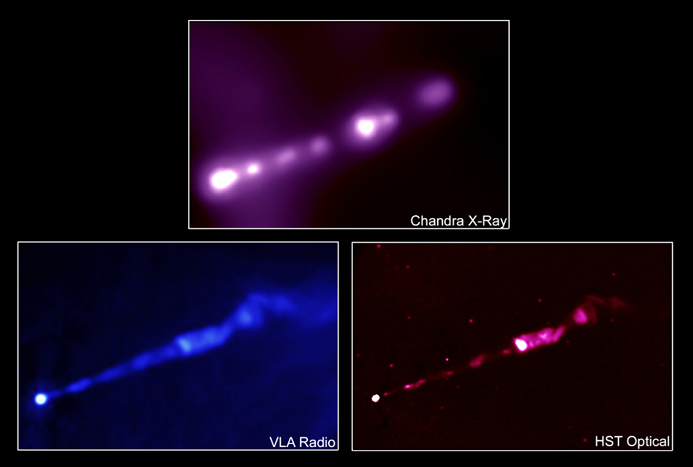
An energetic jet from the core of giant elliptical galaxy M87 stretches outward for 5,000 light-years. This monstrous jet appears in the panels above to be a knotted and irregular structure, detected across the spectrum, from x-ray to optical to radio wavelengths. In all these bands, the observed emission is likely created as high energy electrons spiral along magnetic field lines, so called synchrotron radiation. But what powers this cosmic blowtorch? Ultimately, the jet is thought to be produced as matter near the center of M87 swirls toward a spinning, supermassive black hole. Strong electromagnetic forces are generated and eject material away from the black hole along the axis of rotation in a narrow jet. Galaxy M87 is about 50 million light-years away and reigns as the large central elliptical galaxy in the Virgo cluster. News: The answer to Lewin's Challenge APOD can be found here.