Black Hole
A black hole is an astronomical object whose gravity is so strong that nothing—even light—can escape from within its event horizon. It forms when a massive star’s core collapses or through other processes, and may have an accretion disk of infalling matter that emits radiation. Supermassive black holes at galaxy centers influence stellar orbits, and mergers produce gravitational waves.
Source: nasa.gov
APODs including "Black Hole"
Unexpected X-Rays from Perseus Galaxy Cluster
02/01/2018
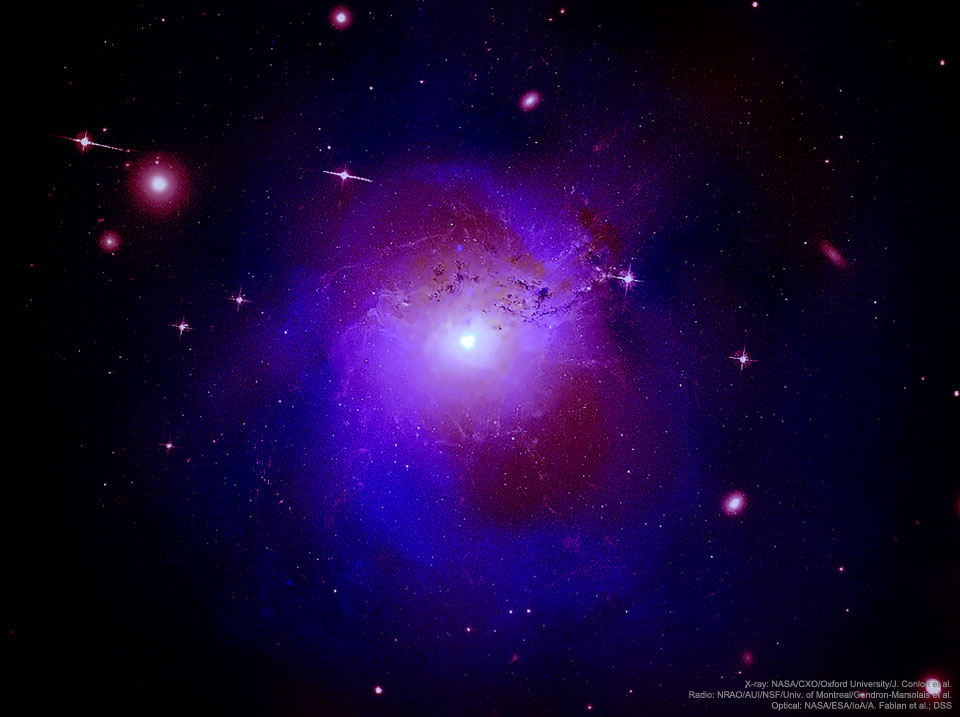
Why does the Perseus galaxy cluster shine so strangely in one specific color of X-rays? No one is sure, but a much-debated hypothesis holds that these X-rays are a clue to the long-sought identity of dark matter. At the center of this mystery is a 3.5 Kilo-electronvolt (KeV) X-ray color that appears to glow excessively only when regions well outside the cluster center are observed, whereas the area directly surrounding a likely central supermassive black hole is actually deficient in 3.5 keV X-rays. One proposed resolution -- quite controversial -- is that something never seen before might be present: fluorescent dark matter (FDM). This form of particle dark matter might be able to absorb 3.5 keV X-radiation. If operating, FDM, after absorption, might later emit these X-rays from all over the cluster, creating an emission line. However, when seen superposed in front of the central region surrounding the black hole, FDM's absorption would be more prominent, creating an absorption line. Pictured, a composite image of the Perseus galaxy cluster shows visible and radio light in red, and X-ray light from the Earth-orbiting Chandra Observatory in blue. Free APOD Lectures: January 5 in NYC & January 9 in DC