Black Hole
A black hole is an astronomical object whose gravity is so strong that nothing—even light—can escape from within its event horizon. It forms when a massive star’s core collapses or through other processes, and may have an accretion disk of infalling matter that emits radiation. Supermassive black holes at galaxy centers influence stellar orbits, and mergers produce gravitational waves.
Source: nasa.gov
APODs including "Black Hole"
An Extreme Black Hole Outburst
11/03/2020
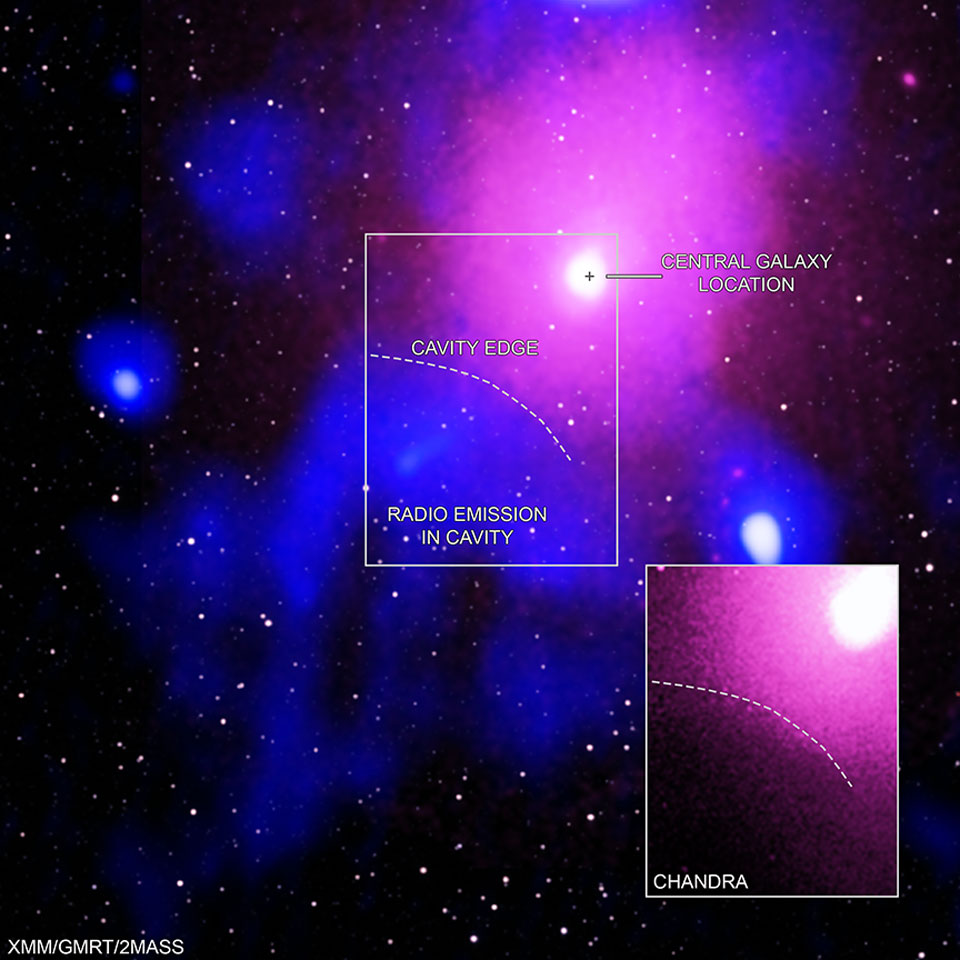
Astronomers believe they have now found the most powerful example of a black hole outburst yet seen in our Universe. The composite, false-color featured image is of a cluster of galaxies in the constellation of Ophiuchus, the serpent-bearer. The composite includes X-ray images (from the Chandra X-ray Observatory and XMM-Newton) in purple, and a radio image (from India's Giant Metrewave Radio Telescope) in blue (along with an infrared image of the galaxies and stars in the field in white for good measure). The dashed line marks the border of a cavity blown out by the supermassive black hole which lurks at the center of the galaxy marked by the cross. Radio emission fills this cavity. This big blowout is believed to be due to the black hole eating too much and experiencing a transient bout of "black hole nausea", which resulted in the ejection of a powerful radio jet blasting into intergalactic space. The amount of energy needed to blow this cavity is equivalent to about 10 billion supernova explosions.