Black Hole
A black hole is an astronomical object whose gravity is so strong that nothing—even light—can escape from within its event horizon. It forms when a massive star’s core collapses or through other processes, and may have an accretion disk of infalling matter that emits radiation. Supermassive black holes at galaxy centers influence stellar orbits, and mergers produce gravitational waves.
Source: nasa.gov
APODs including "Black Hole"
The Galactic Center from Radio to X-ray
31/03/2020
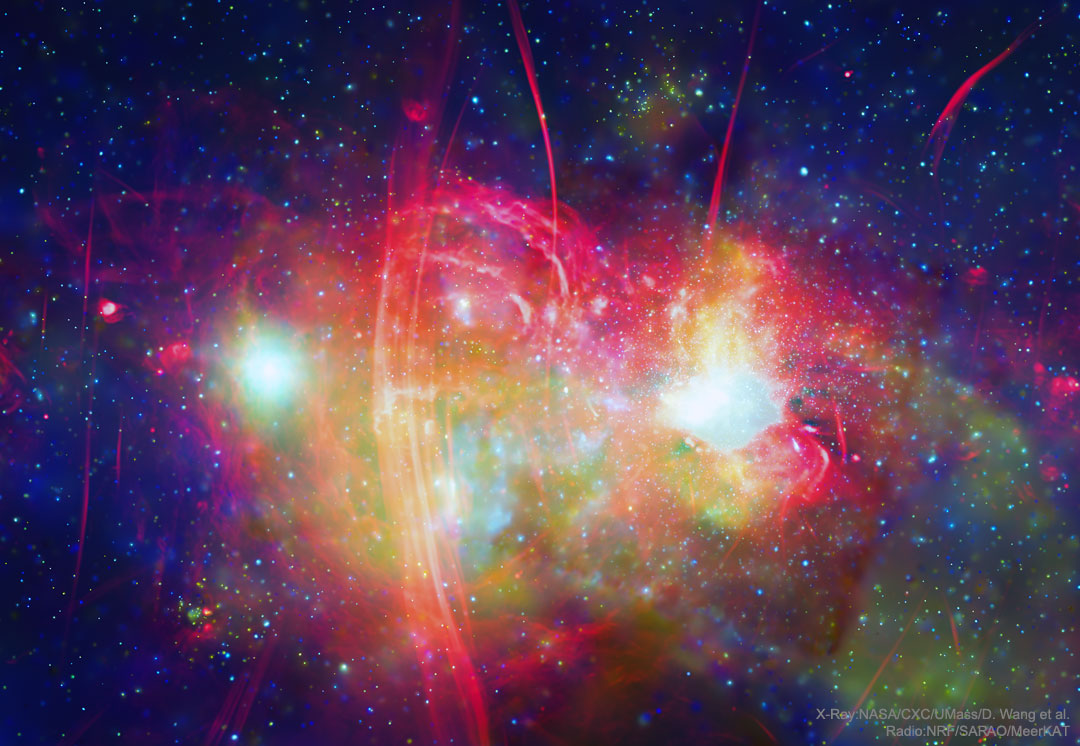
In how many ways does the center of our Galaxy glow? This enigmatic region, about 26,000 light years away toward the constellation of the Archer (Sagittarius), glows in every type of light that we can see. In the featured image, high-energy X-ray emission captured by NASA's orbiting Chandra X-Ray Observatory appears in green and blue, while low-energy radio emission captured by SARAO's ground-based MeerKAT telescope array is colored red. Just on the right of the colorful central region lies Sagittarius A (Sag A), a strong radio source that coincides with Sag A*, our Galaxy's central supermassive black hole. Hot gas surrounds Sag A, as well as a series of parallel radio filaments known as the Arc, seen just left of the image center. Numerous unusual single radio filaments are visible around the image. Many stars orbit in and around Sag A, as well as numerous small black holes and dense stellar cores known as neutron stars and white dwarfs. The Milky Way's central supermassive black hole is currently being imaged by the Event Horizon Telescope. Activities: NASA Science at Home