Black Hole
A black hole is an astronomical object whose gravity is so strong that nothing—even light—can escape from within its event horizon. It forms when a massive star’s core collapses or through other processes, and may have an accretion disk of infalling matter that emits radiation. Supermassive black holes at galaxy centers influence stellar orbits, and mergers produce gravitational waves.
Source: nasa.gov
APODs including "Black Hole"
Centaurus A: A Peculiar Island of Stars
03/05/2023
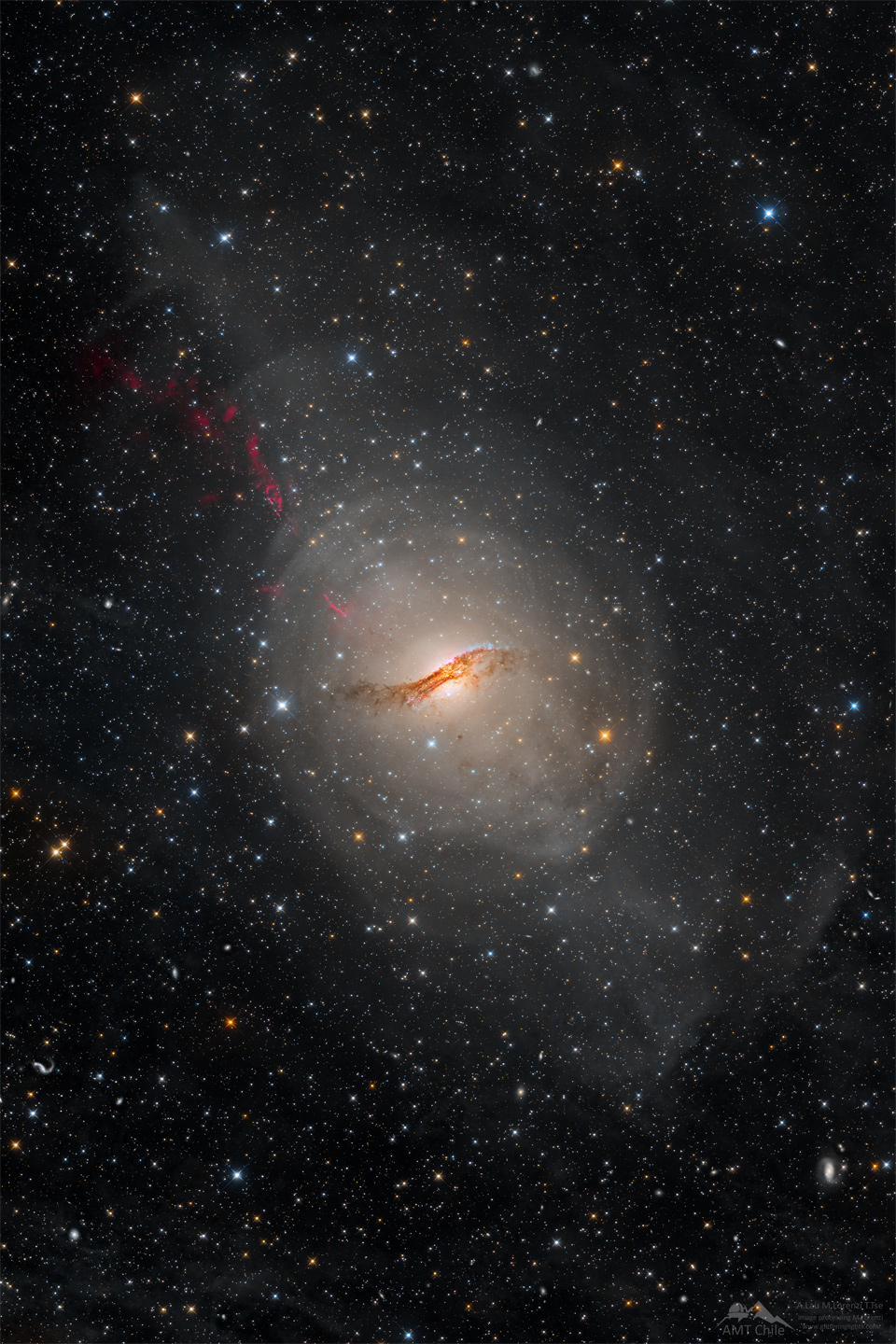
Galaxies are fascinating. In galaxies, gravity alone holds together massive collections of stars, dust, interstellar gas, stellar remnants and dark matter. Pictured is NGC 5128, better known as Centaurus A. Cen A is the fifth brightest galaxy on the sky and is located at a distance of about 12 million light years from Earth. The warped shape of Cen A is the result of a merger between an elliptical and a spiral galaxy. Its active galactic nucleus harbors a supermassive black hole that is about 55 million times more massive than our Sun. This central black hole ejects a fast jet visible in both radio and X-ray light. Filaments of the jet are visible in red in the upper left. New observations by the Event Horizon Telescope have revealed a brightening of the jet only towards its edges -- but for reasons that are currently unknown and an active topic of research. At NASA it's: Black Hole Week