Black Hole
A black hole is an astronomical object whose gravity is so strong that nothing—even light—can escape from within its event horizon. It forms when a massive star’s core collapses or through other processes, and may have an accretion disk of infalling matter that emits radiation. Supermassive black holes at galaxy centers influence stellar orbits, and mergers produce gravitational waves.
Source: nasa.gov
APODs including "Black Hole"
M15: Dense Globular Star Cluster
15/06/2023
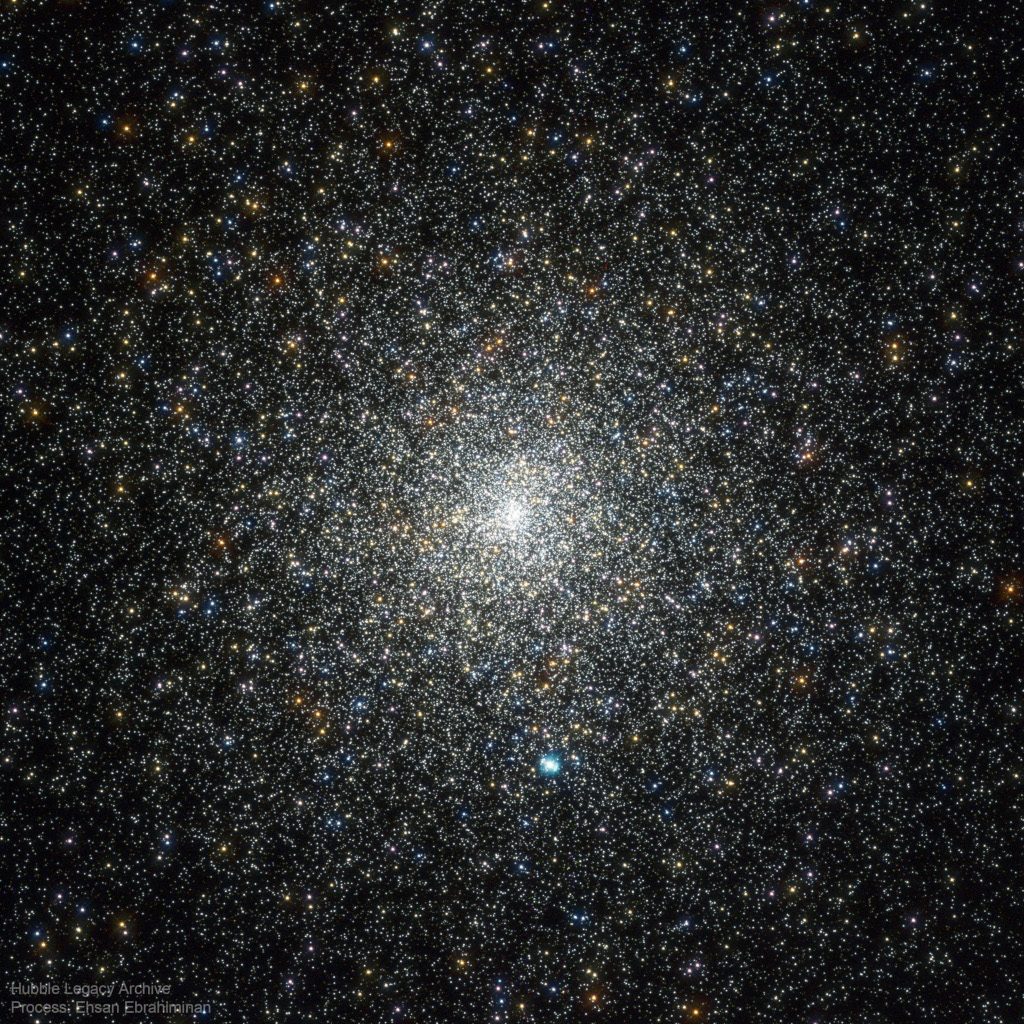
Messier 15 is an immense swarm of over 100,000 stars. A 13 billion year old relic of the early formative years of our galaxy it's one of about 170 globular star clusters that still roam the halo of the Milky Way. Centered in this sharp reprocessed Hubble image, M15 lies some 35,000 light-years away toward the constellation Pegasus. Its diameter is about 200 light-years, but more than half its stars are packed into the central 10 light-years or so, making one of the densest concentrations of stars known. Hubble-based measurements of the increasing velocities of M15's central stars are evidence that a massive black hole resides at the center of the dense cluster. M15 is also known to harbour a planetary nebula. Called Pease 1 (aka PN Ps 1), it can be seen in this image as a small blue blob below and just right of center.