Black Hole
A black hole is an astronomical object whose gravity is so strong that nothing—even light—can escape from within its event horizon. It forms when a massive star’s core collapses or through other processes, and may have an accretion disk of infalling matter that emits radiation. Supermassive black holes at galaxy centers influence stellar orbits, and mergers produce gravitational waves.
Source: nasa.gov
APODs including "Black Hole"
A Message from the Gravitational Universe
29/06/2023
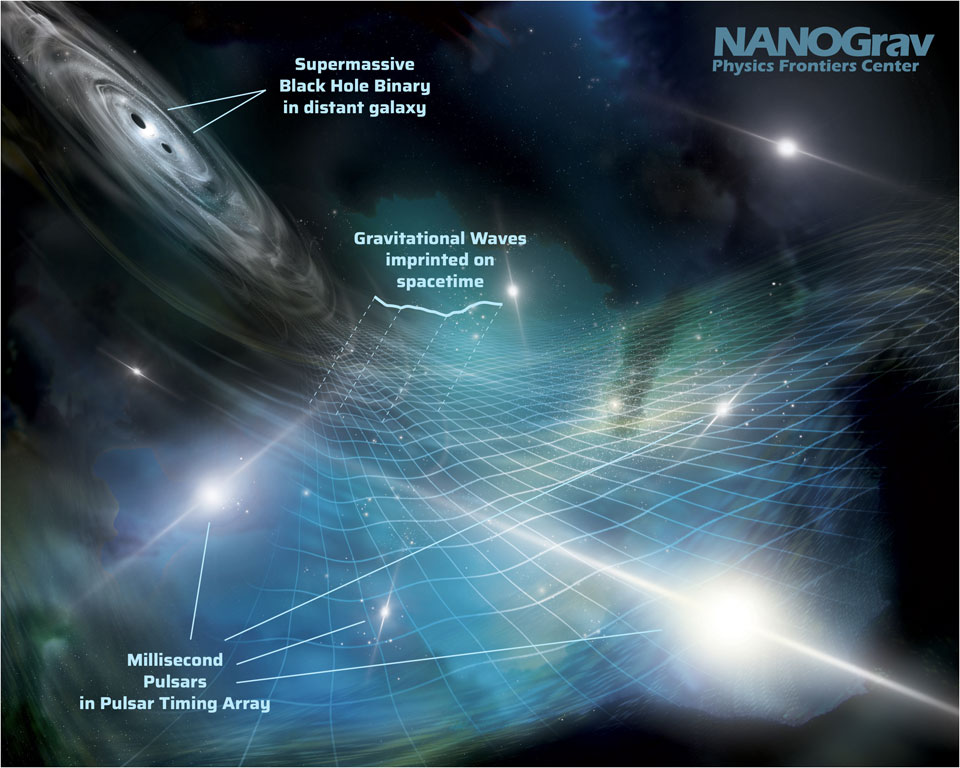
Monitoring 68 pulsars with very large radio telescopes, the North American Nanohertz Observatory for Gravitational Waves (NANOGrav) has uncovered evidence for the gravitational wave (GW) background by carefully measuring slight shifts in the arrival times of pulses. These shifts are correlated between different pulsars in a way that indicates that they are caused by GWs. This GW background is likely due to hundreds of thousands or even millions of supermassive black hole binaries. Teams in Europe, Asia and Australia have also independently reported their results today. Previously, the LIGO and Virgo detectors have detected higher-frequency GWs from the merging of individual pairs of massive orbiting objects, such as stellar-mass black holes. The featured illustration highlights this spacetime-shaking result by depicting two orbiting supermassive black holes and several of the pulsars that would appear to have slight timing shifts. The imprint these GWs make on spacetime itself is illustrated by a distorted grid. Open Science: Browse 3,000+ codes in the Astrophysics Source Code Library