Black Hole
A black hole is an astronomical object whose gravity is so strong that nothing—even light—can escape from within its event horizon. It forms when a massive star’s core collapses or through other processes, and may have an accretion disk of infalling matter that emits radiation. Supermassive black holes at galaxy centers influence stellar orbits, and mergers produce gravitational waves.
Source: nasa.gov
APODs including "Black Hole"
The Shells and Jets of Galaxy Centaurus A
11/12/2024
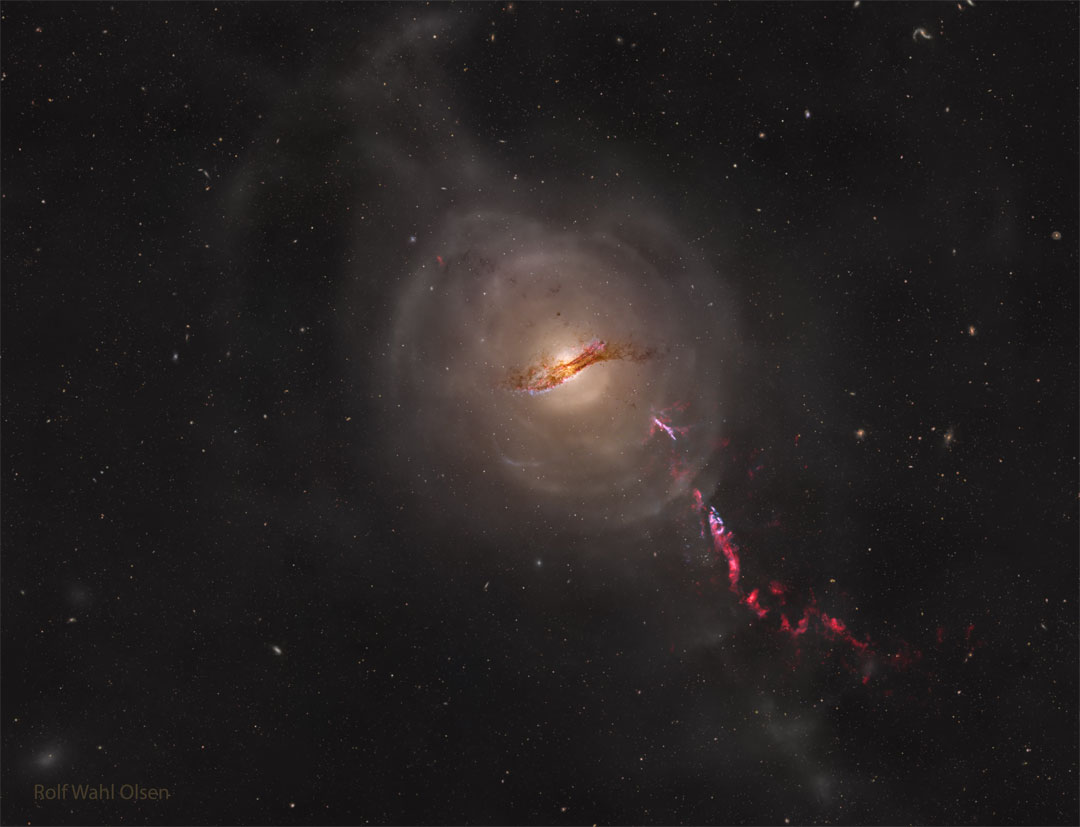
What's the closest active galaxy to planet Earth? That would be Centaurus A, cataloged as NGC 5128, which is only 12 million light-years distant. Forged in a collision of two otherwise normal galaxies, Centaurus A shows several distinctive features including a dark dust lane across its center, outer shells of stars and gas, and jets of particles shooting out from a supermassive black hole at its center. The featured image captures all of these in a composite series of visible light images totaling over 310 hours captured over the past 10 years with a homebuilt telescope operating in Auckland, New Zealand. The brightness of Cen A's center from low-energy radio waves to high-energy gamma rays underlies its designation as an active galaxy. Astrophysicists: Browse 3,500+ codes in the Astrophysics Source Code Library