Black Hole
A black hole is an astronomical object with gravity so strong that nothing—not even light—can escape once it passes its event horizon, the boundary around the singularity.
Stellar black holes form when massive stars (∼20× the Sun’s mass) exhaust their nuclear fuel, undergo supernova explosions, and collapse under gravity into a point with extreme density and curvature of spacetime. If the remnant core exceeds roughly three solar masses, no known force can resist the collapse.
Supermassive black holes—millions to billions of solar masses—reside at the centers of most galaxies, including the Milky Way. Evidence comes from tracking orbital motion of stars in their vicinity, as observed by NASA and ESA facilities, evidence that earned the 2020 Nobel Prize.
Black holes are invisible, but their presence is inferred from accretion disks—hot gas swirling around them emits powerful X-rays—and from gravitational lensing, where their mass bends light from background objects.
Observations by the Event Horizon Telescope (EHT) produced direct images of the shadow of black holes in M87 and Sagittarius A*, confirming Einstein’s predictions about light structure near the event horizon.
Some black holes move at high speeds through space, likely receiving small velocity boosts (often called kicks) from asymmetric supernova explosions or galactic interactions, as detected using Hubble’s precision astrometry.
Black holes also play key roles in cosmic evolution. Tidal disruption events—where a passing star is torn apart—produce luminous flares captured by Hubble and Chandra, providing rare glimpses into black hole activity.
Their immense gravity powers active galactic nuclei and relativistic jets, influencing both their surrounding galaxies and intergalactic environments.
Sources
APODs including "Black Hole"
Messier 104
29 May 2026
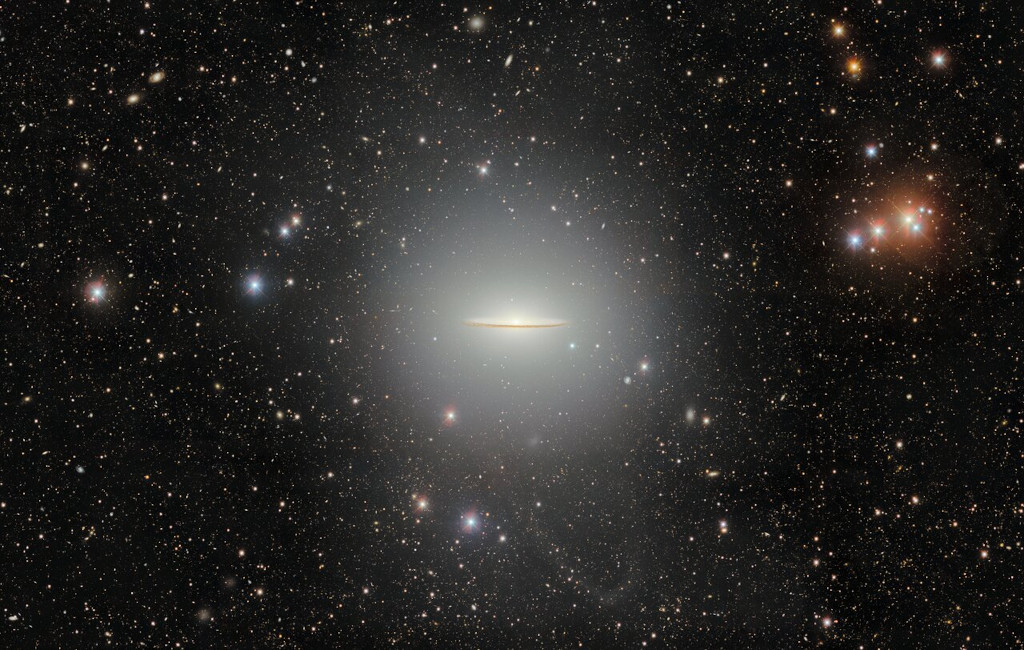
A gorgeous spiral galaxy, Messier 104 is famous for its nearly edge-on profile featuring a broad ring of obscuring dust lanes. Seen in silhouette against an extensive central bulge of stars, the swath of cosmic dust lends a broad brimmed hat-like appearance to the galaxy suggesting a more popular moniker, the Sombrero Galaxy. Also known as NGC 4594, the Sombrero galaxy can be seen across the spectrum and is host to a central supermassive black hole. About 50,000 light-years across and 28 million light-years away, M104 is one of the largest galaxies at the southern edge of the Virgo Galaxy Cluster. Still, the spiky foreground stars in this field of view lie well within our own Milky Way. This broad view of the well-known galaxy was processed to reveal M104's extended halo, as well as a faint tidal stellar stream. It was captured by the Dark Energy Camera (DECam) on the Blanco 4-meter telescope at the Cerro Tololo Inter-American Observatory.