Cassiopeia
Cassiopeia is a prominent northern constellation named after the vain queen of Greek mythology. Notable for its distinctive “W” asterism formed by five bright stars, it lies along the plane of the Milky Way and contains many deep-sky objects, including the supernova remnant Cassiopeia A and star‑forming regions such as IC 63.
Source: nasa.gov
APODs including "Cassiopeia"
NGC 7635: The Bubble Nebula
17/11/1998
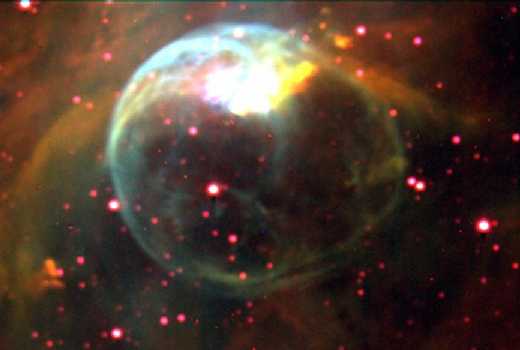
What created this huge space bubble? A massive star that is not only bright and blue, but also emitting a fast stellar wind of ionized gas. The Bubble Nebula is actually the smallest of three bubbles surrounding massive star BD+602522, and part of gigantic bubble network S162 created with the help of other massive stars. As fast moving gas expands off BD+602522, it pushes surrounding sparse gas into a shell. The energetic starlight then ionizes the shell, causing it to glow. The Bubble Nebula, also known as NGC 7635, is about 10 light-years across and visible with a small telescope towards the constellation of Cassiopeia.