Cassiopeia
Cassiopeia is a prominent northern constellation named after the vain queen of Greek mythology. Notable for its distinctive “W” asterism formed by five bright stars, it lies along the plane of the Milky Way and contains many deep-sky objects, including the supernova remnant Cassiopeia A and star‑forming regions such as IC 63.
Source: nasa.gov
APODs including "Cassiopeia"
Chandra's First Light: Cassiopeia A
27/08/1999
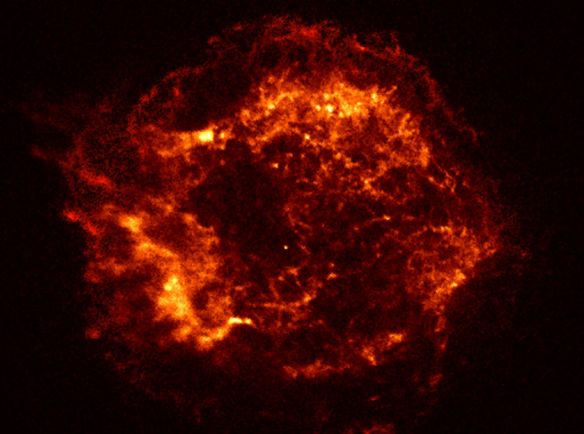
Cosmic wreckage from the detonation of a massive star is the subject of this official first image from NASA's Chandra X-ray Observatory. The supernova remnant, known as Cassiopeia A, was produced when a star exploded around 300 years ago in this northern sky constellation. It is revealed here in unprecedented detail in the light of X-rays - photons with thousands of times the energy of visible light. Shock waves expanding at 10 million miles-per-hour are seen to have heated this 10 light-year diameter bubble of stellar debris to X-ray emitting temperatures of 50 million kelvins. The tantalizing bright speck near the bubble's center could well be the dense, hot remnant of the stellar core collapsed to form a newborn neutron star. With this and other first light images, the Chandra Observatory is still undergoing check out operations in preparation for its much anticipated exploration of the X-ray sky. Chandra was launched aboard the space shuttle Columbia in July.