Cassiopeia
Cassiopeia is a prominent northern constellation named after the vain queen of Greek mythology. Notable for its distinctive “W” asterism formed by five bright stars, it lies along the plane of the Milky Way and contains many deep-sky objects, including the supernova remnant Cassiopeia A and star‑forming regions such as IC 63.
Source: nasa.gov
APODs including "Cassiopeia"
NGC 7635: The Bubble
18/10/2006
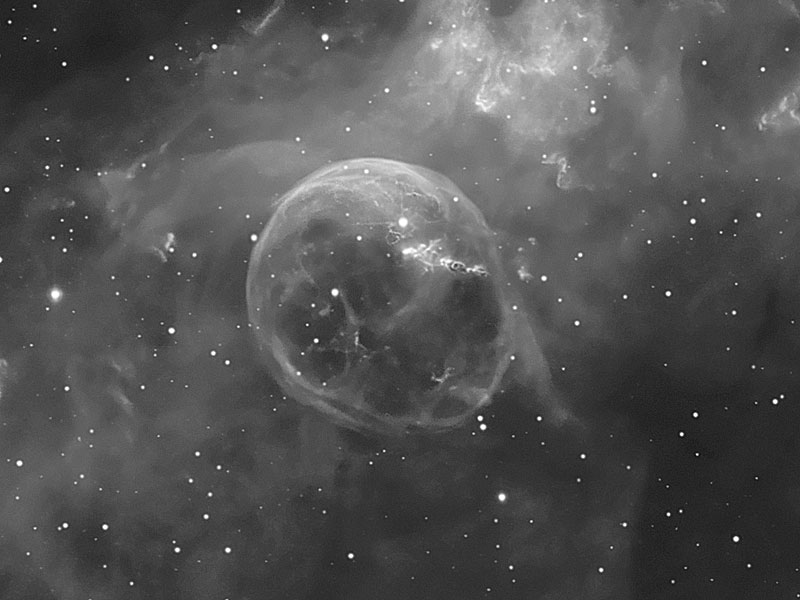
What created this huge space bubble? Blown by the wind from a star, this tantalizing, ghostly apparition is cataloged as NGC 7635, but known simply as The Bubble Nebula. Astronomer Eric Mouquet's striking view utilizes a long exposure with hydrogen alpha light to reveal the intricate details of this cosmic bubble and its environment. Although it looks delicate, the 10 light-year diameter bubble offers evidence of violent processes at work. Seen here above and right of the Bubble's center is a bright hot star embedded in reflecting dust. A fierce stellar wind and intense radiation from the star, which likely has a mass 10 to 20 times that of the Sun, has blasted out the structure of glowing gas against denser material in a surrounding molecular cloud. The intriguing Bubble Nebula lies a mere 11,000 light-years away toward the boastful constellation Cassiopeia.