Cassiopeia
Cassiopeia is a prominent northern constellation named after the vain queen of Greek mythology. Notable for its distinctive “W” asterism formed by five bright stars, it lies along the plane of the Milky Way and contains many deep-sky objects, including the supernova remnant Cassiopeia A and star‑forming regions such as IC 63.
Source: nasa.gov
APODs including "Cassiopeia"
IC 1805: The Heart Nebula
14/02/2009
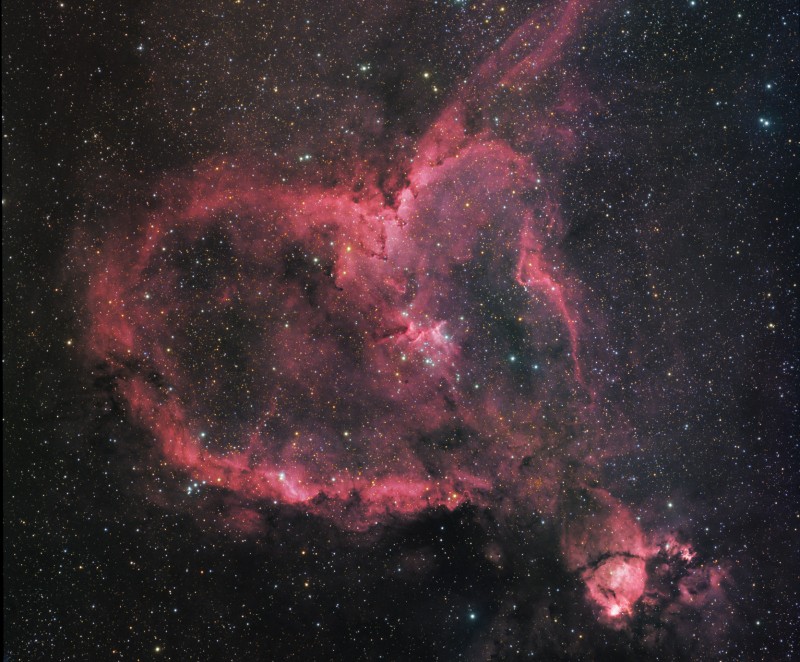
Sprawling across almost 200 light-years, emission nebula IC 1805 is a mix of glowing interstellar gas and dark dust clouds. Derived from its Valentine's-Day-approved shape, its nickname is the Heart Nebula. About 7,500 light-years away in the Perseus spiral arm of our galaxy, stars were born in IC 1805. In fact, near the cosmic heart's center are the massive hot stars of a newborn star cluster also known as Melotte 15, about 1.5 million years young. A little ironically, the Heart Nebula is located in the constellation Cassiopeia. From Greek mythology, the northern constellation is named for a vain and boastful queen. This deep view of the region around the Heart Nebula, cropped from a larger mosaic, spans about 2.5 degrees on the sky or about 5 times the diameter of the Full Moon.