Cassiopeia
Cassiopeia is a prominent northern constellation named after the vain queen of Greek mythology. Notable for its distinctive “W” asterism formed by five bright stars, it lies along the plane of the Milky Way and contains many deep-sky objects, including the supernova remnant Cassiopeia A and star‑forming regions such as IC 63.
Source: nasa.gov
APODs including "Cassiopeia"
Starburst Galaxy IC 10
09/10/2009
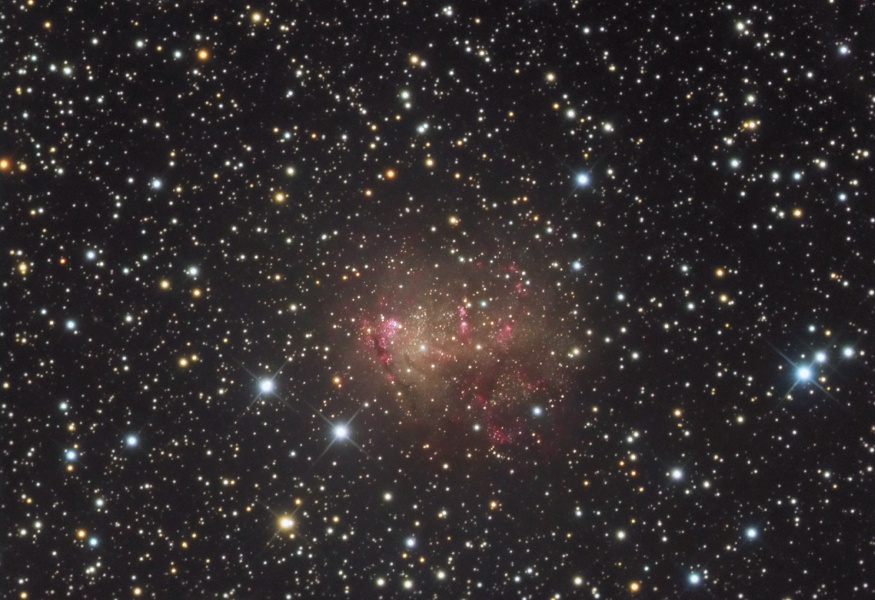
Lurking behind dust and stars near the plane of our Milky Way Galaxy, IC 10 is a mere 2.3 million light-years distant. Its light dimmed by the intervening dust, the irregular dwarf galaxy still shows off vigorous star-forming regions that shine with a telltale reddish glow in this colorful skyscape. In fact, also a member of the Local Group of galaxies, IC 10 is the closest known starburst galaxy. Compared to other Local Group galaxies, IC 10 has a large population of newly formed stars that are massive and intrinsically very bright, including a luminous X-ray binary star system thought to contain a black hole. Located within the boundaries of the northern constellation Cassiopeia, IC 10 is about 5,000 light-years across.