Cassiopeia
Cassiopeia is a prominent northern constellation named after the vain queen of Greek mythology. Notable for its distinctive “W” asterism formed by five bright stars, it lies along the plane of the Milky Way and contains many deep-sky objects, including the supernova remnant Cassiopeia A and star‑forming regions such as IC 63.
Source: nasa.gov
APODs including "Cassiopeia"
The Bubble and M52
30/10/2009
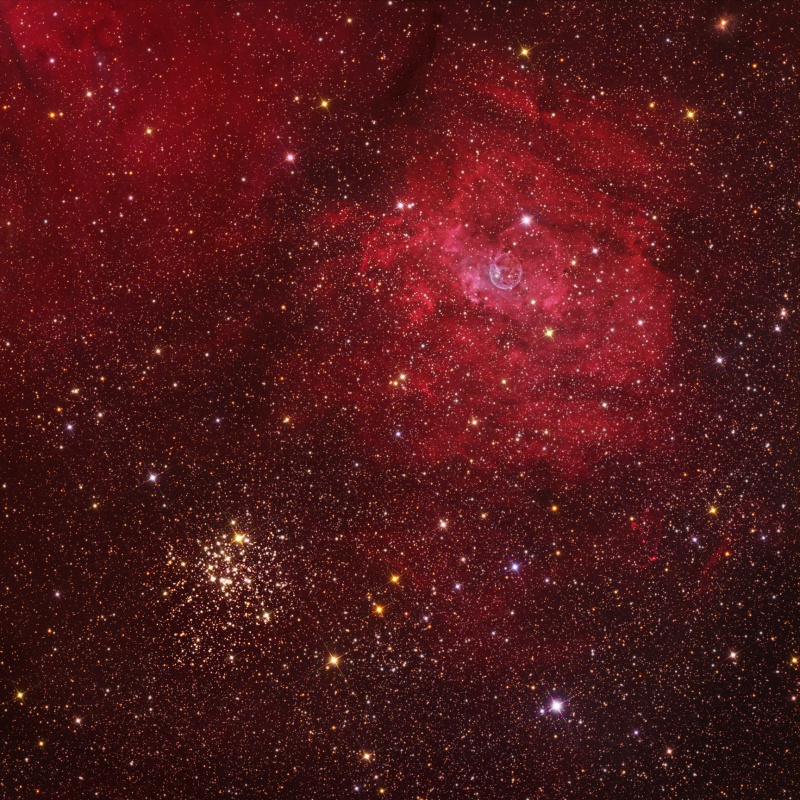
To the eye, this cosmic composition nicely balances the Bubble Nebula at the upper right with open star cluster M52. The pair would be lopsided on other scales, though. Embedded in a complex of interstellar dust and gas and blown by the winds from a single, massive O-type star, the Bubble Nebula (aka NGC 7635) is a mere 10 light-years wide. On the other hand, M52 is a rich open cluster of around a thousand stars. The cluster is about 25 light-years across. Seen toward the northern boundary of Cassiopeia, distance estimates for the Bubble Nebula and associated cloud complex are around 11,000 light-years, while star cluster M52 lies nearly 5,000 light-years away.