Cassiopeia
Cassiopeia is a prominent northern constellation named after the vain queen of Greek mythology. Notable for its distinctive “W” asterism formed by five bright stars, it lies along the plane of the Milky Way and contains many deep-sky objects, including the supernova remnant Cassiopeia A and star‑forming regions such as IC 63.
Source: nasa.gov
APODs including "Cassiopeia"
Cooling Neutron Star
05/03/2011
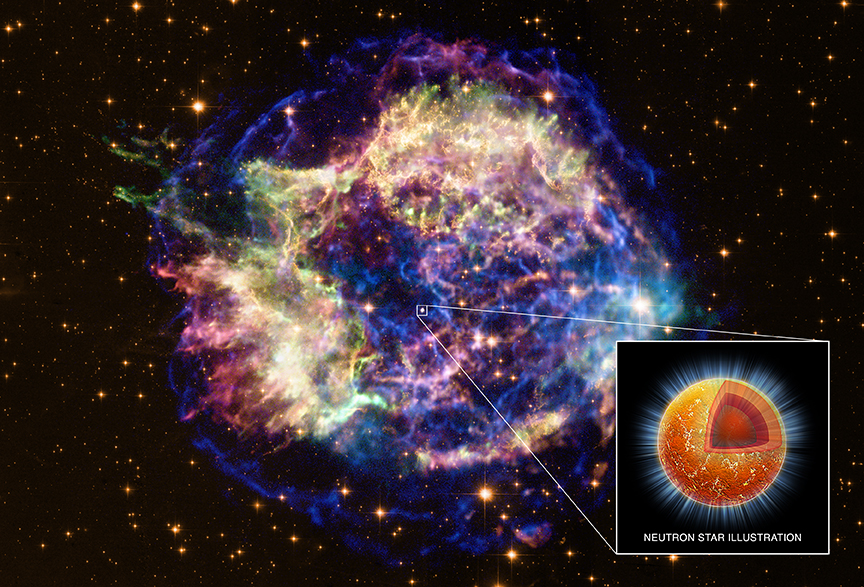
Supernova remnant Cassiopeia A (Cas A) is a comfortable 11,000 light-years away. Light from the Cas A supernova, the death explosion of a massive star, first reached Earth just 330 years ago. The expanding debris cloud spans about 15 light-years in this composite X-ray/optical image, while the bright source near the center is a neutron star (inset illustration) the incredibly dense, collapsed remains of the stellar core. Still hot enough to emit X-rays, Cas A's neutron star is cooling. In fact, 10 years of observations with the orbiting Chandra X-ray observatory find that the neutron star is cooling rapidly, so rapidly that researchers suspect a large part of the neutron star's core is forming a frictionless neutron superfluid. The Chandra results represent the first observational evidence for this bizarre state of neutron matter.