Cassiopeia
Cassiopeia is a prominent northern constellation named after the vain queen of Greek mythology. Notable for its distinctive “W” asterism formed by five bright stars, it lies along the plane of the Milky Way and contains many deep-sky objects, including the supernova remnant Cassiopeia A and star‑forming regions such as IC 63.
Source: nasa.gov
APODs including "Cassiopeia"
The Heart Nebula in Hydrogen, Oxygen, and Sulfur
27/08/2017
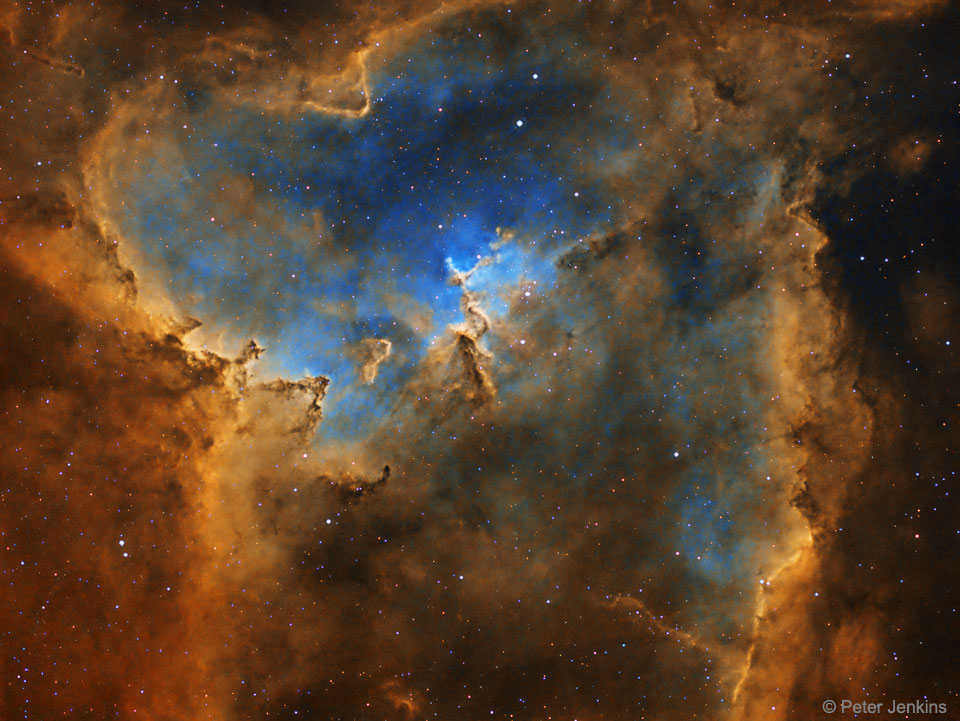
What powers the Heart Nebula? The large emission nebula dubbed IC 1805 looks, in whole, like a heart. The nebula's glow -- as well as the shape of the gas and dust clouds -- is powered by by stellar winds and radiation from massive hot stars in the nebula's newborn star cluster Melotte 15. This deep telescopic image maps the pervasive light of narrow emission lines from atoms of hydrogen, oxygen, and sulfur in the nebula. The field of view spans just over two degrees on the sky, so that it appears larger than four times the diameter of a full moon. The cosmic heart is found in the constellation of Cassiopeia, the boastful mythical Queen of Aethiopia .