Cassiopeia
Cassiopeia is a prominent northern constellation named after the vain queen of Greek mythology. Notable for its distinctive “W” asterism formed by five bright stars, it lies along the plane of the Milky Way and contains many deep-sky objects, including the supernova remnant Cassiopeia A and star‑forming regions such as IC 63.
Source: nasa.gov
APODs including "Cassiopeia"
NGC 7635: Bubble in a Cosmic Sea
26/10/2017
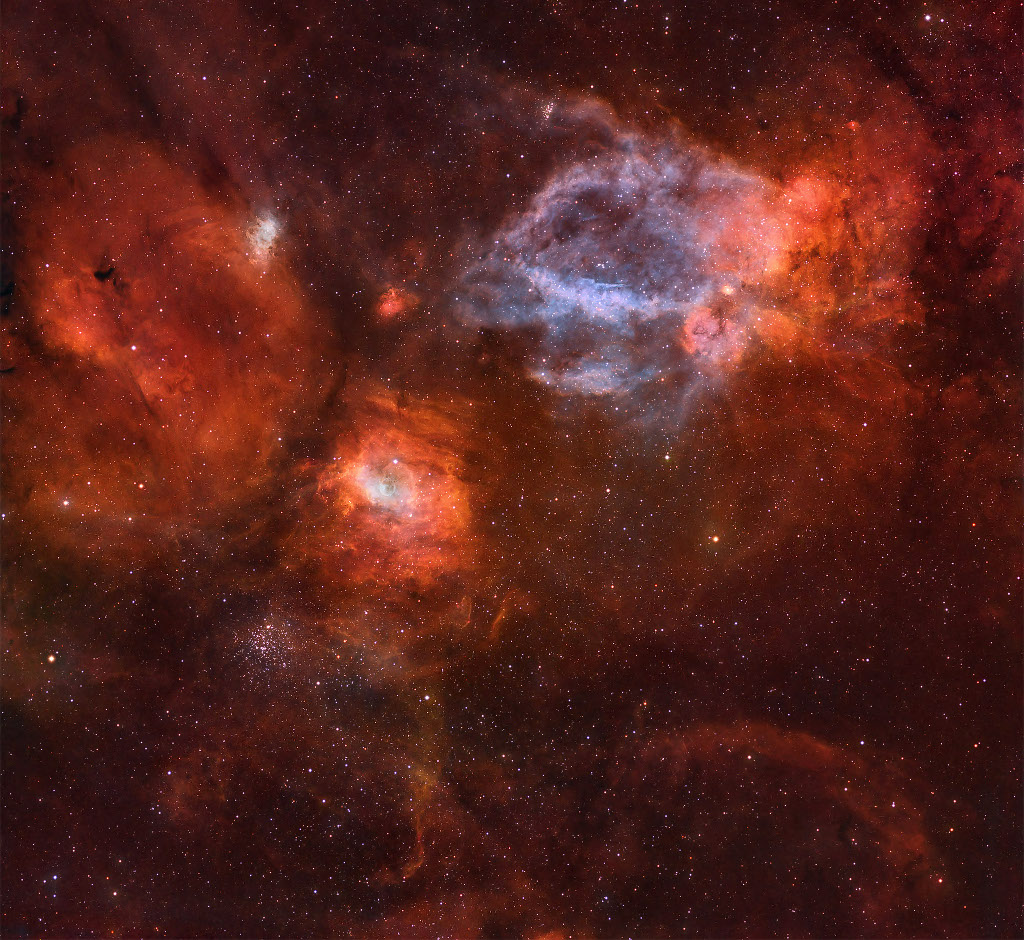
Adrift in a cosmic sea of stars and glowing gas the delicate, floating apparition left of center in this widefield view is cataloged as NGC 7635, the Bubble Nebula. A mere 10 light-years wide, the tiny Bubble Nebula was blown by the winds of a massive star. It lies within a larger complex of interstellar gas and dust clouds found about 11,000 light-years distant, straddling the boundary between the parental constellations Cepheus and Cassiopeia. Included in the breathtaking vista is open star cluster M52 (lower left), some 5,000 light-years away. Above and right of the Bubble Nebula is an emission region identified as Sh2-157, also known as the Claw Nebula. Constructed from 47 hours of narrow-band and broad-band exposures, this image spans about 3 degrees on the sky. That corresponds to a width of 500 light-years at the estimated distance of the Bubble Nebula.