Cassiopeia
Cassiopeia is a prominent northern constellation named after the vain queen of Greek mythology. Notable for its distinctive “W” asterism formed by five bright stars, it lies along the plane of the Milky Way and contains many deep-sky objects, including the supernova remnant Cassiopeia A and star‑forming regions such as IC 63.
Source: nasa.gov
APODs including "Cassiopeia"
Glowing Elements in the Soul Nebula
21/08/2018
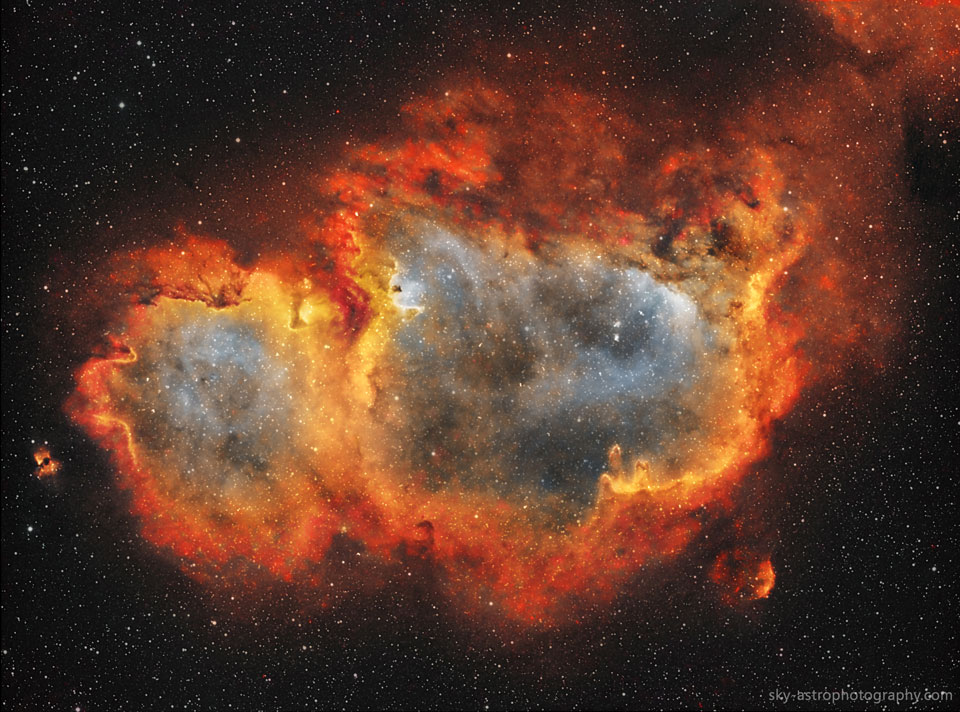
Stars are forming in the Soul of the Queen of Aethopia. More specifically, a large star forming region called the Soul Nebula (IC 1898) can be found in the direction of the constellation Cassiopeia, who Greek mythology credits as the vain wife of a King who long ago ruled lands surrounding the upper Nile river. The Soul Nebula houses several open clusters of stars, a large radio source known as W5, and huge evacuated bubbles formed by the winds of young massive stars. Located about 6,500 light years away, the Soul Nebula spans about 100 light years and is usually imaged next to its celestial neighbor the Heart Nebula (IC 1805). The featured image is a composite of three exposures in different colors: red as emitted by hydrogen gas, yellow as emitted by sulfur, and blue as emitted by oxygen. News: New APOD mirror in French