Cassiopeia
Cassiopeia is a prominent northern constellation named after the vain queen of Greek mythology. Notable for its distinctive “W” asterism formed by five bright stars, it lies along the plane of the Milky Way and contains many deep-sky objects, including the supernova remnant Cassiopeia A and star‑forming regions such as IC 63.
Source: nasa.gov
APODs including "Cassiopeia"
Dust Clouds of the Pacman Nebula
10/08/2022
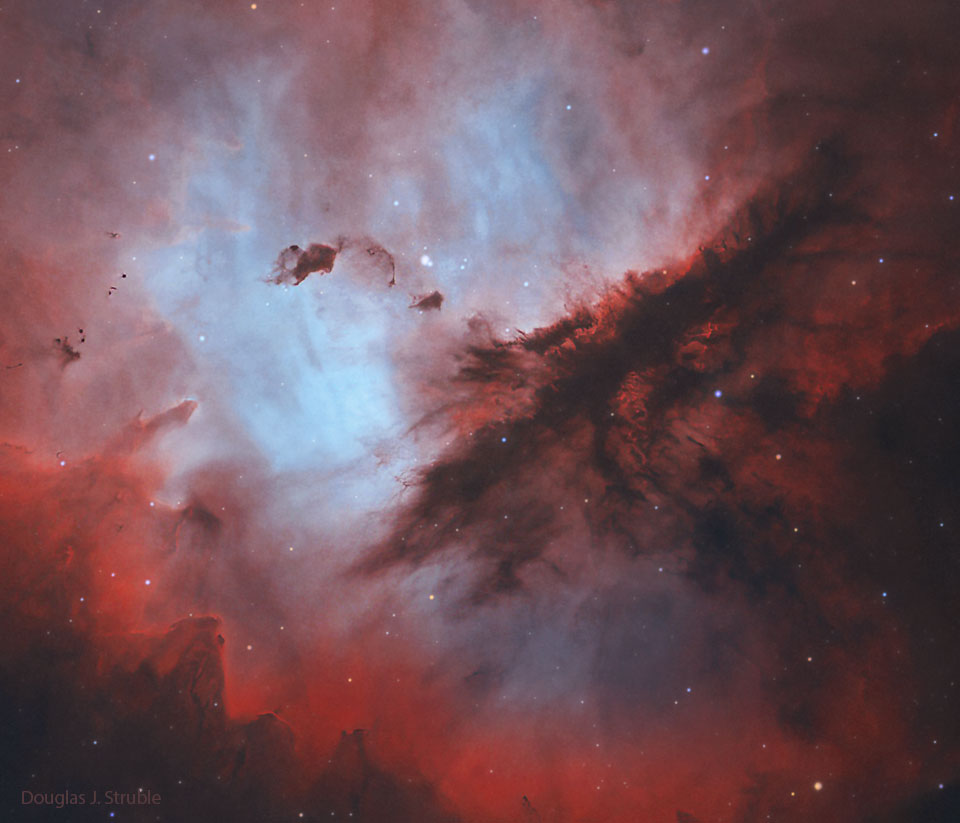
Stars can create huge and intricate dust sculptures from the dense and dark molecular clouds from which they are born. The tools the stars use to carve their detailed works are high energy light and fast stellar winds. The heat they generate evaporates the dark molecular dust as well as causing ambient hydrogen gas to disperse and glow red. Pictured here, a new open cluster of stars designated IC 1590 is nearing completion around the intricate interstellar dust structures in the emission nebula NGC 281, dubbed the Pac-man Nebula because of its overall shape. The dust cloud on the upper left is classified as a Bok Globule as it may gravitationally collapse and form a star -- or stars. The Pacman Nebula lies about 10,000 light years away toward the constellation of Cassiopeia.