Cassiopeia
Cassiopeia is a prominent northern constellation named after the vain queen of Greek mythology. Notable for its distinctive “W” asterism formed by five bright stars, it lies along the plane of the Milky Way and contains many deep-sky objects, including the supernova remnant Cassiopeia A and star‑forming regions such as IC 63.
Source: nasa.gov
APODs including "Cassiopeia"
Deep Field: The Heart Nebula
13/12/2023
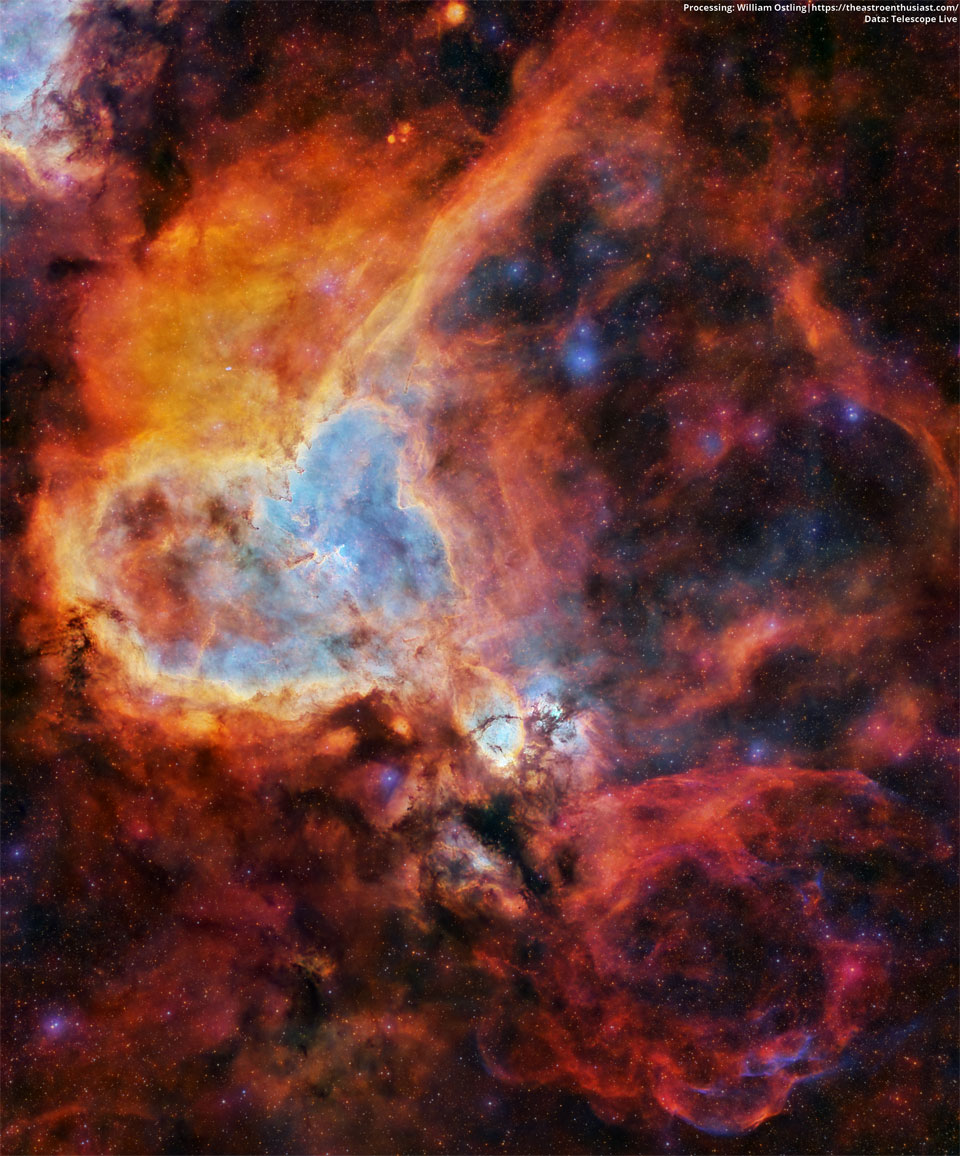
What excites the Heart Nebula? First, the large emission nebula on the left, catalogued as IC 1805, looks somewhat like a human heart. The nebula glows brightly in red light emitted by its most prominent element, hydrogen, but this long-exposure image was also blended with light emitted by silicon (yellow) and oxygen (blue). In the center of the Heart Nebula are young stars from the open star cluster Melotte 15 that are eroding away several picturesque dust pillars with their atom-exciting energetic light and winds. The Heart Nebula is located about 7,500 light years away toward the constellation of Cassiopeia. At the bottom right of the Heart Nebula is the companion Fishhead Nebula. This wide and deep image clearly shows, though, that glowing gas surrounds the Heart Nebula in all directions. Tonight watch: The Geminids